







Drug-Free Communities (DFC)
Drug-Free Communities (DFC) Support Program
The Drug-Free Communities (DFC) Support Program, created by the Drug-Free Communities Act of 1997, is the Nation’s leading effort to mobilize communities to prevent youth substance use. Directed by ONDCP in partnership with CDC, the DFC program provides grants to over 500 community coalitions to strengthen the infrastructure among local partners to create and sustain a reduction in local youth substance use.
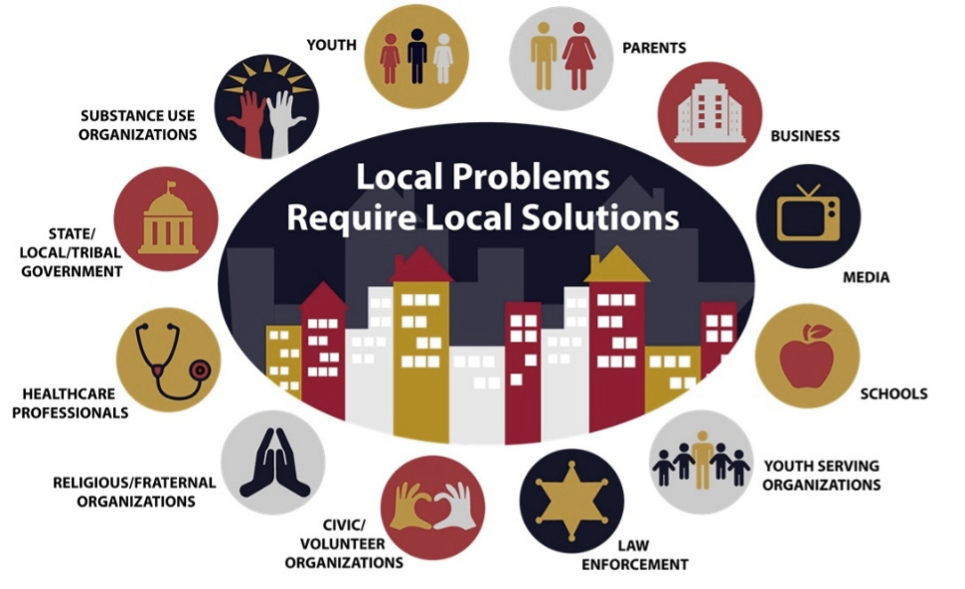
DFC coalitions bring together representatives from 12 community sectors to build strong local partnerships focused on preventing youth substance use. By engaging youth, parents, schools, business, media, law enforcement, faith-based/fraternal organizations, healthcare professionals, civic/volunteer groups, state, local and/or tribal governments, youth-serving organizations, and other key stakeholders, coalitions create data-driven action plans tailored to local needs. The majority of DFC-funded coalitions focus on preventing youth use of alcohol, tobacco, marijuana, prescription drug, opioids, including fentanyl and fentanyl analogs, methamphetamine, and xylazine use.
An estimated 62 million people (18 percent of the U.S. population) lived in communities served by DFC-funded coalitions in 2025. This included approximately 2.4 million middle school youth ages 12 to 14 (18 percent of all middle school youth) and about 3.2 million high school youth ages 15 to 18 (18 percent of all high school youth). Across DFC-funded coalitions in 2025, approximately 42,600 community members were mobilized to engage in prevention efforts, including approximately 10,800 youth.
Coalitions conduct regular needs assessments and use local data to identify priorities, guide planning, and measure progress. Central to this work is understanding the risk factors that increase the likelihood of youth substance use, as well as the protective factors that help young people thrive and make healthy choices. Using this information, coalitions implement comprehensive, evidence-based strategies designed to strengthen protective environments, reduce risk, and prevent youth substance use across the community.
Program Impacts
- Protecting America’s Youth and Communities | In 2025 alone, an estimated 62 million people, 18% of the population in the United States, lived in a community served by a DFC coalition. This reach includes an estimated 2.4 million middle school–aged youth and 3.2 million high school–aged youth, young people at critical developmental stages when prevention matters most.
- Addressing Emerging Drug Threats | In addition to sustained prevention efforts addressing alcohol, marijuana, and tobacco, 75% of coalitions addressed opioids and/or methamphetamine use. Among those coalitions, the majority focused on prescription opioids and fentanyl.
- Shifting Norms and Strengthening Protective Factors | DFC coalitions implement comprehensive, evidence-based prevention strategies. Many strategies address key risk factors that increase the likelihood of youth substance use while strengthening protective factors that support healthy development. Among DFC coalitions, 70% implemented social norms campaigns to address misperceptions around youth substance use.
- Faith-Based Protective Factors | Most coalitions reported youth having broad access to a range of faith-based services in the community (84%), one of the strongest protective factors present in DFC communities. Coalitions also perceived that youth feel connected to a faith-based community or a positive adult from the faith community (76%).
Grant Recipients
High Intensity Drug Trafficking Area
Through the High Intensity Drug Trafficking Areas (HIDTA) Program, ONDCP supports collaborative Federal, state, local, and Tribal law enforcement and public health efforts to address overdoses and disrupt drug trafficking and production.
About
Created by Congress in 1988, the High Intensity Drug Trafficking Areas (HIDTA) Program coordinates and assists federal, state, local, and Tribal law agencies to address regional drug threats with the purpose of reducing drug trafficking and drug production in the United States.
The HIDTA Program oversees 33 regional HIDTAs in all 50 states, Puerto Rico, the U.S. Virgin Islands, and the District of Columbia. Nationwide, the program comprises more than 900 investigative, interdiction, and intelligence-sharing initiatives. Regional HIDTAs also collaborate closely with public health partners on innovative strategies to reduce fatal and non-fatal overdoses and substance use.
Each HIDTA is guided by an Executive Board that includes an equal number of regional federal and non-federal (state, local, and Tribal) law enforcement leaders and is managed by an Executive Director who has previous experience in public safety. Law enforcement officials interested in participating in the HIDTA Program can view the Designation Process below for more information.
For more information about the HIDTAs’ work and successes, see the Program Impacts below.
To view the 2023 HIDTA Designation Map, click here.
Program Impacts
Since its inception in 1988, the HIDTA Program has helped public safety officials implement integrated operations against drug trafficking organizations and, with ONDCP’s leadership, has provided the American people with a cost-effective solution to address addiction and the overdose crisis. In 2022, the HIDTAs seized an estimated $22 billion in illicit drugs and cash—representing a return on investment of $82.91 for every $1 budgeted for the HIDTA Program.
- Removing drugs from our streets. By interdicting and seizing drugs off our shores and within our borders, HIDTAs remove the supply of illicit substances, making it harder for drug trafficking organizations (DTOs) to sell their products. In 2021, the HIDTA Program seized and disposed of over 193 metric tons of cocaine products, 195 metric tons of methamphetamine, 2,900 metric tons of marijuana, 4 metric tons of heroin, and 9 metric tons of fentanyl.
- Dismantling drug trafficking organizations. By targeting DTOs, the HIDTAs focus on the entities responsible for the majority of the production, movement, and sales of illicit drugs. In 2021, the HIDTAs disrupted and dismantled over 3,155 DTOs, 59 percent of which were part of international or multi-state operations.
- Promoting best practices and innovations. As a result of the HIDTA Program’s national footprint, public safety officials across the country can share their best practices and information with each other and, because of ONDCP’s neutrality, the HIDTAs can share on-the-ground intelligence with federal agencies for better drug policy.
- Preventing substance misuse through comprehensive programming. By establishing alliances with public health, healthcare, education, recreation, and other relevant sectors, the HIDTAs help create comprehensive community-based prevention efforts.
- Enhancing officers’ safety and coordination. In 2021, the HIDTAs helped public safety agencies share more than 1 million pieces of evidence to unearth connections between cases and perform more than 287,000 event deconflictions, actions that can alert law enforcement officials when their tactical operations are occurring in the same general location and timeframe as other agencies. This has reduced unnecessary officer injuries and contributed to more equitable and appropriate arrests and convictions.
A comprehensive report on HIDTA program accomplishments is available here.
Designation Process
ONDCP accepts petitions for county-based HIDTA designation on an ongoing basis and reviews these applications at least once a year. Regional law enforcement agencies may petition ONDCP for designation as a HIDTA, but new applicants typically request to be admitted to the closest-established HIDTA. Applicants can click here for the Executive Directors’ contact information.
Criteria for Applying
Congress has established the following criteria for determining if a county should receive HIDTA designation:
- The area is a significant center for illegal drug production, manufacturing, importation, or distribution;
- State, local, and Tribal law enforcement agencies have committed resources to address the drug trafficking problem in the area, thereby indicating a determination to respond aggressively to the problem;
- Drug-related activities in the area are having a harmful impact in the area and in other areas of the country; and
- A significant increase in allocation of federal resources is necessary to respond adequately to drug-related activities in the area.
Petitioning ONDCP for HIDTA status
The HIDTA Program does not have a pre-set application. Applicants can submit their petition to ONDCP for HIDTA designation by presenting relevant information in sections corresponding to the four criteria listed above. More information about the requirements of the petition process can be found in the Federal Register.
Applicants should direct any questions and completed petitions to ONDCP’s HIDTA program.
To view the current grant terms and conditions, click here.
To view previous grant terms and conditions, click here.
Combating Overdose through Community-Level Intervention
Combating Overdose through Community-Level Intervention (COCLI) is a collaborative effort between ONDCP and the Centers for Disease Control and Prevention (CDC) to implement and evaluate community-based efforts to fight the overdose epidemic. These efforts support innovative approaches to help the regions and populations within the United States that suffer from the highest rates of fatal and non-fatal drug overdoses.
The recipient of the 2022 COCLI cooperative agreement is the University of Baltimore’s Center for Drug Policy and Prevention, which provides opportunities for communities to receive COCLI funding through competitive subawards. Additional information is available here.
To view the current cooperative agreement terms and conditions, please click here.
To view previous cooperative agreement terms and conditions, please click here.
State Model Laws
The White House Office of National Drug Control Policy, in partnership with the Legislative Analysis and Public Policy Association (LAPPA), has developed several Model State Drug Laws to serve as a resource for states in the development effective substance use disorder policies. These model laws include:
- Model Law Enforcement and Other First Responders Deflection Act: Encourages the use and establishment of deflection programs on the state level. Deflection programs provide proactive policing to assist individuals who are at risk and offer pathways to treatment, recovery services, housing, medication for addiction treatment, whole family services, and other needed supports.
- Model Syringe Services Program Act: Authorizes the establishment of comprehensive syringe services programs, which are associated with a decrease in bloodborne infectious disease diagnoses as well as the number of needlestick injuries to first responders and others.
- Model Expanded Access to Emergency Opioid Antagonists Act: Provides state officials with the means to increase the ability of their citizens to access and use life-saving emergency opioid antagonists. Opioid antagonists, such as naloxone, which can be used during emergencies to reverse opioid overdoses and are effective in preventing fatal drug overdoses.
- Model Opioid Litigation Proceeds Act: Assists states in their efforts to maximize funds available to address the overdose crisis through the establishment of a dedicated fund, separate from the state’s general treasury fund, that is designated for substance use disorder abatement, including prevention, treatment, recovery, and harm reduction infrastructure, programs, services, supports, and resources. All proceeds received by the state arising out of legal claims made against manufacturers and distributors of prescription opioid analgesics, pharmacies that dispensed prescription opioid analgesics, and related parties shall be deposited into the dedicated fund.
- Model Overdose Fatality Review Teams Act: Assists states in setting up county-level, multidisciplinary teams to identify challenges unique to a local area. It addresses the duties, responsibilities, and composition of Overdose Fatality Review (OFR) teams in order for them to properly examine and understand the circumstances leading up to a fatal overdose.
- Model Overdose Mapping and Response Act: Assists states in addressing overdose incident reporting. The Model Act requires a state (or other jurisdiction) to create an overdose mapping and response system using ODMAP where all law enforcement officers, other first responders, medical examiners, and coroners must report certain information about a confirmed or suspected overdose incident within 24 hours.
Additionally, LAPPA has released reports on timely drug policy topics:
- Performance Measures for Medication-assisted Treatment in Correctional Settings: A Framework for Implementation: This report provides professionals at correctional settings with a performance management framework to monitor medication treatment for opioid use disorder in correctional settings and recommends twelve performance measures to track key activities associated with corrections-based medication treatment programs and their impacts.
- Telehealth and Substance Use Disorder Services in the Era of COVID-19: Review and Recommendations: This report found that telehealth services can provide increased access to vulnerable individuals with substance use disorder, decrease costs, and reduce spread of communicable diseases.
Model law descriptions retrieved from the Legislative Analysis and Public Policy Association.
State officials interested in implementing model laws can contact ONDCP with any questions or requests for additional information.
Grants Tracking Resources
In 2018, as part of the ONDCP reauthorization, which was embedded in the larger Substance Use-Disorder Prevention that Promotes Opioid Recovery and Treatment (SUPPORT) for Patients and Communities Act of 2018 (P.L. 115-271) Congress created a requirement (21 U.S.C. §1704 (f)) for ONDCP to establish a tracking and reporting system for federally funded drug-related grant programs. The purpose of the new laws is to:
- Ensure the public has electronic access to information identifying: all drug control grants and pertinent identifying information for each grant; any available performance metrics, evaluations, or other information indicating the effectiveness of such programs
- Facilitate efforts to identify duplication, overlap, or gaps in funding to provide increased accountability of Federally funded grants for substance use disorder treatment, prevention, and enforcement
- Identify barriers in the grant application process impediments that applicants currently have in the grant application process with applicable agencies.
In response to this requirement ONDCP established a process to collect drug-related grant information from all national drug control program agencies with drug control grant programs. This information is consolidated into web links at Grants.Gov and USASpending.Gov. Although there is some overlap between the systems, generally the Grants.Gov link is the best source for currently available funding opportunities while USASpending.Gov has a deeper history of past grant programs. The specific links are below.
Links:
Grants.Gov: Search Grants | GRANTS.GOV
USASpending.Gov: Federal Awards | Advanced Search | USAspending
Note that once on the specific website, the information can be tailored in a number of ways, including by agency, by keyword, and by fiscal year. For example, information on grants.gov include links by “opportunity number.” Clicking on that number brings you to a dedicated description of the program and more information about the program, how to apply, and additional information and web links. Agencies provide available performance and outcome data within their program documents under each grant program.
Contacts:
As referenced above, specific information about agency grants are embedded within each specific agency grant. Agencies awarding the grants are the best source for specific information about their programs. For information about ONDCP grant programs or about the grant tracking process, please contact us at: performancebudgetcoordinator@ondcp.eop.gov
ONDCP’s Grant Programs:
The Drug-Free Communities (DFC) Support Program is the Nation’s leading effort to mobilize communities to prevent youth substance use. All FY 2021 grant award recipients are here. DFC performance information can be found here.
The High Intensity Drug Trafficking Areas (HIDTA) Program, since its inception in 1988, has helped public safety officials implement integrated operations against drug trafficking organizations. FY 2021 HIDTA grant awards announcements can be found here, here, and here. HIDTA Program performance information can be found here.