
















Science A New Golden Age
Letter of Transmittal
DEAR MR. PRESIDENT:
Eighty-one years ago, President Franklin D. Roosevelt wrote a letter to Vannevar Bush, tasking him with reorganizing America’s scientific enterprise after World War II. Bush’s response was a report, titled Science: The Endless Frontier. It established the Federal Government’s role in supporting basic science, led to the creation of the National Science Foundation, and shaped our nation’s science and technology strategy for decades afterward. That report was foundational to the American Century and to the technological world in which we live today.
Now, as we celebrate the United States’ 250th anniversary, we have the responsibility to renew our foundations once more. Never have science and technology been more central to our nation’s security and prosperity, and, although America continues to set the pace of scientific progress, global competitors are racing to challenge our leadership. This historical moment demands that we modernize our institutions to match the achievements of our past and the ambitions of our future.
In your letter of March 26, 2025, on the occasion of my Senate confirmation as Director of the Office of Science and Technology Policy, you challenged me to reexamine America’s research and development ecosystem in light of changes brought on by the 21st century.
The report I present here diagnoses the obstacles American researchers face today, and the ways our scientific enterprise has fundamentally transformed since its basic organization was established in 1945. Though our investments in research have grown, scientific productivity has slowed. We have become dependent on a narrow set of legacy institutions. Our incentive structures reward conformity over bold inquiry. And the capacity that once turned American discoveries into American strength has eroded, undermined by decades of industrial offshoring.
To address these and related challenges, this report puts forward recommendations for the entire scientific and technological ecosystem, across government, academia, philanthropy, and industry. Underlying all of these recommendations is a simple measure of success. A decade from now, American researchers should look back at our work and say: “The vital questions I could not pursue then, I am free to pursue now.” That purpose will be achieved if we make progress toward four overarching goals.
First, the U.S. research system should prioritize the individual scientist over legacy institutions. If we are serious about expanding what our scientists can do, we must invest directly in American researchers and the bold ideas that drive them. Too much of our research enterprise has come to serve itself rather than the scientists within it. Federal funding agencies should support a broader range of performers, including a new generation of mission-driven research organizations, to expand our scientific horizons. And these agencies should organize themselves around the interdisciplinary frontiers of science today, rather than the academic silos of the last century.
Second, the Federal Government should fundamentally change how research dollars are allocated, distributed, and assessed. Instead of a one-size-fits-all approach, the government should fund more flexible types of grants, including fast-track grants, long-horizon grants, and new mechanisms that allow reviewers to champion radically unconventional proposals. Federal research agencies should evaluate their own performance as capital allocators, test new ways of making grants, and construct portfolios with the intentionality of a serious investor.
Third, the Federal Government should set clear scientific goals and build the industrial muscle to translate scientific discovery into technological strength. The greatest technical achievements of the last century came about because leaders in government identified national priorities and marshaled the resources to accomplish them. As our competitors race us to capture the value chain of strategic technologies, including with tactics we would never countenance, we can no longer assume that the fruits of American science will accrue to our own people. Government must mobilize the full force of our enterprise around national challenges, clear the ground for American builders, and reunite the work of discovery and manufacturing across the country.
Fourth, we must prepare our research enterprise for the AI revolution. AI will accelerate and radically transform the way we do science. But even the most capable AI models will be slowed down in the bottleneck of institutions and systems built for the last century. As we renew the infrastructure that powers American science, we must reengineer it for the AI age. And even as AI compresses the time from question to answer, we will still need human hands to build the instrument or prototype. We must build that capacity, too, investing in advanced manufacturing, the skilled trades, and the vast pools of talent and tacit knowledge outside the traditional academic pipeline.
In preparing this report, I have consulted widely across the country’s scientific enterprise, from entrepreneurs driving world-changing breakthroughs in fusion technology, to researchers eager to pursue bold ideas in neuroscience at our universities, to venture capitalists funding revolutionary platforms for drug discovery. Their message is clear and inspiring: given the right conditions, American ingenuity will continue to achieve the impossible.
Throughout our history, Americans have shown remarkable courage in their willingness to reinvent our institutions when the challenges we faced demanded it, from establishing the land-grant university to creating the National Science Foundation to launching the Apollo Program. Each generation has seized its opportunity to expand the frontiers of knowledge and lay down the paving stones of progress. Now it is our time to build the scientific enterprise that will carry America forward and bring prosperity to Americans through the 21st century and beyond.
Mr. President, you have called for a Golden Age of American Innovation. This report is the map to that vision. Our nation cured polio, placed men on the Moon, decoded the human genome, and launched the digital revolution. With your leadership, we will extend our scientific and technological might into the Second American Century and continue to deliver the innovations and discoveries that define the modern world.
Respectfully submitted,
Michael Kratsios
Assistant to the President for Science and Technology
Director, Office of Science and Technology Policy
July 21, 2026
President Trump's Letter
March 26, 2025
Dear Mr. Kratsios:
Scientific progress and technological innovation were the twin engines that powered the American century. The Manhattan Project fueled the atomic era. The Apollo Program won us the space race. The internet connected us to a digital future. Today, we will usher in the Golden Age of American Innovation. We will make America safer, healthier, and more prosperous than ever before. We will create a future of American greatness for every citizen, restoring the American Dream.
The triumphs of the last century did not happen by chance. As World War II drew towards a close, President Franklin D. Roosevelt wrote a letter like this one to his science and technology advisor, Vannevar Bush, charging him to explore new frontiers of the mind for the sake of national greatness and pioneer science in peacetime. Dr. Bush’s response laid the groundwork for the uniquely successful American partnership of Government, industry, and academia that built the greatest and most productive nation in human history.
But today, rivals abroad seek to usurp America’s position as the world’s greatest maker of marvels and producer of knowledge. We must recapture the urgency which propelled us so far in the last century. The time has come to return to our roots and renew the American scientific enterprise for the century ahead. So, just as FDR tasked Vannevar Bush, I am tasking you with meeting the challenges below to deliver for the American people.
First: How can the United States secure its position as the unrivaled world leader in critical and emerging technologies—such as artificial intelligence, quantum information science, and nuclear technology—maintaining our advantage over potential adversaries?
We need to accelerate research and development, dismantle regulatory barriers, strengthen domestic supply chains and manufacturing, spur robust private sector investment, and advance American companies in global markets. Rival nations are pushing hard to overtake the United States, and we must blaze a bold path to maintain our technological supremacy.
Second: How can we revitalize America’s science and technology enterprise—pursuing truth, reducing administrative burdens, and empowering researchers to achieve groundbreaking discoveries?
We need new paradigms for the research enterprise, including innovative models for funding and sharing scientific research, redefining how America conducts the business of discovery. We must build an ecosystem that attracts top talent, celebrates merit, protects our intellectual edge, and enables scientists to focus on meaningful work rather than administrative box checking.
Third: How can we ensure that scientific progress and technological innovation fuel economic growth and better the lives of all Americans?
During my first term, we made unprecedented advances in America’s scientific and technological leadership. We launched the American Artificial Intelligence Initiative, vaulting the United States to the front of the pack in the development and deployment of artificial intelligence. Our National Quantum Initiative established the foundation for national quantum supremacy. We created the United States Space Force and charted a new and daring course for America’s further exploration of space. All of this buttressed our security and bolstered our prosperity, and it reaffirmed America’s place as the world’s preeminent technological superpower.
Now, after four long years of weakness and complacency, we must set our sights even higher. I am calling upon you to blaze a trail to the next frontiers of science. We have the opportunity to cement America’s global technological leadership and usher in the Golden Age of American Innovation. We are not just competing with other nations; we are seeking, striving, fighting to make America greater than ever before.
Sincerely,
Donald J. Trump
President of the United States
Summary of the Report
Chapter I: Introduction
American scientific progress was the beating heart of the 20th century. It delivered victory on the battlefields of World War II, secured America’s triumph in the Cold War, and produced the most prosperous nation in human history. We developed the alchemy that taught sand how to think, conjuring the digital world from silicon chips. American science conquered polio, placed men on the Moon, and gave humanity general-purpose artificial intelligence (AI). This leadership has improved lives and defined the very structure of our modern world.
The foundation of these profound advancements was laid in the years following World War II, thanks largely to the vision set out by Vannevar Bush, the chief science advisor to Presidents Roosevelt and Truman. In his canonical 1945 report, Science: The Endless Frontier, Bush made the prescient case for federal support of basic research, laying the groundwork for the modern scientific enterprise. That enterprise, however, was predominantly built around what became called the “linear model” of technical progress, flowing from basic research to applied research to development of technology and industry. A simplification even then, that model has grown increasingly inadequate as a description of progress eighty-one years later. Discovery today is most often an iterative loop between fundamental and applied work, with industry and engineering playing a vital part in spurring even basic research.
Government funding of research and development, especially basic science in the academy and national labs, has rightly grown in the eight decades since Bush’s report. But private industry has become by far the largest source of research and development (R&D) funding in the United States, with its share nearly doubling from the 1950s to today. American companies now deploy around $700 billion annually, more than triple the combined spending from government and higher education. This evolution has made the pie bigger for everybody and should be welcomed across the research ecosystem, but it demands a corresponding adjustment to the nature of the Federal Government’s contributions.
New challenges have arisen in recent decades. Despite massive increases in biomedical funding since the 1990s, the rate of significant breakthroughs appears to have slowed and drug approvals have flatlined. Researchers today often spend half their time on paperwork and administrative tasks, a burden worsened by expanding federal and university bureaucracies that further reduce funding available for actual science. A smaller proportion of American citizens now fill post-graduate spots in science, technology, engineering, and mathematics (STEM) fields. Our competitors are channeling unprecedented resources into science and engineering, taking a whole-of-society approach to seize the high ground in strategic technologies. The AI revolution, meanwhile, is transforming the conduct of science, and legacy scientific institutions and infrastructure are not ready to take full advantage of this transformation.
America has led the world in scientific progress because Americans have refused to stand still. We have adapted to changing conditions before by boldly reinventing how we structure science, and we must innovate again. Never has scientific and technological development been more essential to our national and economic security, and never has this progress been so deeply intertwined with our diplomatic relationships worldwide.
President Trump has been very clear about his priorities, as he seeks to lay the foundations for a new Golden Age of American Innovation. He has asked this administration to revitalize the national science enterprise, to secure U.S. leadership in emerging technologies against foreign rivals, and to ensure that all of America’s citizens will benefit from new scientific breakthroughs and technological transformations. The President understands the American story as one of ambition, discovery, and invention, of pioneers who forever seek new frontiers for exploration, particularly now in science and technology.
The President understands the American story as one of ambition, discovery, and invention, of pioneers who forever seek new frontiers for exploration, particularly now in science and technology.
The following chapters provide recommendations, insights, and guidance to the entire U.S. scientific enterprise, from the government to universities to the private sector and philanthropy.
Chapter II: Revitalizing America’s Science and Technology Enterprise
To reverse stagnation and restore breakthrough momentum, the Federal Government must free American scientists to do their best work. Federal funding in academia remains anchored to mid-century assumptions, channeled through traditional disciplines and overly focused on short, project-based grants. Review panels often gatekeep proposals by consensus, disincentivizing transformative ideas. Agencies face little corrective pressure when portfolios underperform. We must strip away unnecessary burdens, realign funding toward excellence and risk-taking, and embed continuous, evidence-based improvement across an approximately $200 billion annual R&D portfolio.
- Refocus on the Individual Scientist: Put the working researcher back at the center of America’s scientific enterprise. Free them from the growing administrative burdens that now weigh them down for nearly half their working hours. Bet on people, not just projects, by expanding portable graduate fellowships like the National Science Foundation (NSF) Graduate Research Fellowship Program (GRFP), backing early-career independence, and scaling long-horizon grants for the best and brightest modeled on National Institutes of Health (NIH) Director’s Pioneer Award. Open alternative pathways beyond standard academia, and ensure that selection rests purely on merit, not the political fashions of the day.
- Diversify Funding Mechanisms: Move beyond consensus-driven peer review by adopting a broader menu of selection mechanisms suited to different kinds of science. Examples include “golden tickets” that empower individual reviewers to champion ambitious proposals, fast grants that deliver rapid funding decisions, prize challenges and advanced market commitments that pay for results, and regranting models that delegate funding authority to scientists to draw on distributed expertise.
- Create New Institutional Models: Many of today’s most important problems are too large for an academic lab, too cross-disciplinary for a single department, and too hard to commercialize for a private corporation. Federal funding should support a wider range of performers. The recently launched X-Labs can assemble agile, time-bound teams of professional scientists and engineers to break specific bottlenecks. Advanced Research Projects Agencies (ARPAs) can empower individual program managers to make bold bets and curate researchers to execute them. Curiosity-driven institutes can give our best minds the stability needed to pursue fundamental questions over long time horizons.
- Reduce Bureaucratic Burdens: Requirements on federal grants have ballooned over the past decades. Some grants now take nearly two years from submission to award, almost as long as it took to design and produce the first Boeing 747. Compress review cycles, eliminate duplicative reporting, and rein in indirect cost recovery that supports administrative bloat, redirecting that money to real scientific infrastructure. Advance reforms that reduce grant-writing burdens, with relief directed specifically to early-career researchers.
- Institutionalize Continuous Improvement: Funders should bring the same critical attention to their own performance that they are supposed to bring to the review of grant applications. Stand up an empowered metascience unit in federal science agencies, reporting directly to the director, with authority to run controlled experiments on review and funding mechanisms and to drive change across the organization. Elevate the prestige of program officers, grow their discretion in setting scientific direction, and support them as the architects of the fields they help shape.
Chapter III: Securing U.S. Dominance in Critical and Emerging Technologies
America has the world’s most vibrant scientific enterprise and most dynamic private sector, which routinely turns novel ideas into new industries. But scientific leadership alone does not guarantee national strength or economic vitality. We must tightly couple our science and technology enterprises to ensure that groundbreaking ideas invented in the United States are rapidly prototyped, tested, manufactured, and scaled domestically.
- Restore Permissionless Innovation: American regulators have grown skilled at weighing the risks of action, but blind to the costs of inaction. Developing good rules require real-world evidence, and building that evidence base only comes from letting innovators prototype and experiment. Extend the President’s reforms in nuclear, pharmaceuticals, and drones across other sectors. Weigh benefits alongside risks, streamline permitting, and use regulatory sandboxes to test new technologies under controlled conditions.
- Open Federal Infrastructure to American Builders: The Federal Government has facilities and testbeds no startup can replicate on its own. Broaden industry access to America’s laboratory research infrastructure, including at Department of Energy (DOE) national laboratories, National Aeronautics and Space Administration (NASA) centers, and Department of War (DOW) facilities. Consider innovative potential alongside scientific merit in use approvals, streamline Cooperative Research and Development Agreements (CRADAs) and licensing, further leverage Other Transaction Authority (OTA) to enable private-sector engagement in co-designing research directions, and expand partnerships with the private sector to make joint investments into cutting-edge equipment.
- Strengthen Public-Private Partnerships and Talent Flows: The university is no longer the only home of America’s most innovative scientific research. Expand agency-adjacent foundations, focus Small Business Innovation Research (SBIR) and Small Business Technology Transfer (STTR) programs to build strategic capabilities, and support joint centers among industry, academia, and federal facilities. Scale industry Ph.D. and postdoc fellowships that move talent fluidly between sectors, drawing on America’s private sector strengths to bring industry-scale resources to our academic researchers.
- Organize Pre-Competitive Consortia and Grand Challenges: The Apollo Program and the Human Genome Project succeeded because the Federal Government marshaled scientific effort at a scale no single institution could match. Leverage grand challenges that pull breakthroughs forward, and create moonshot-scale missions for issues of national importance. Support industry consortia and use federal resources to break shared engineering bottlenecks in foundational areas, as Extreme Ultraviolet Limited Liability Company (EUV LLC) did for semiconductor lithography.
- Use Counties and States as Laboratories: Federalism is one of America’s greatest assets. States can experiment with regulation, permitting, and economic incentives in ways the Federal Government cannot replicate. Support state-led experimentation, partner with the jurisdictions that move the fastest, and let localities compete to support regional innovation. Ensure that innovation strategies that work spread across the nation, advancing science and technology in every county and state.
Chapter IV: Ensuring That Science and Technology Better the Lives of All Americans
America’s scientific creativity and entrepreneurial culture position us to translate breakthroughs into technologies that enrich every American’s life. That enrichment should include the creation of manufacturing jobs, not just the development of consumer products. By rebuilding the link between science and hands-on craft, federal leadership can ensure that the economic returns of discovery, including the jobs, supplier networks, and process knowledge encoded in the hands of workers, accrue to Americans in every region of the country and every sector of the economy, sustaining our technological leadership for generations to come.
- Integrate Hands-On Training: Technology is encoded not just in papers and patents, but in the tacit knowledge passed from mentor to mentee. Require universities and community colleges to embed practical technical training and externships into STEM curricula. Let hands-on experience and industry credentials count toward degrees. Reform accreditation, admissions, and tenure to reward real-world technical work alongside academic publication.
- Open Scientific Careers Beyond the Academic Ladder: Establish national fellowships for skilled craftspeople, practitioner-in-residence programs embedding machinists and technicians alongside Ph.D. researchers, and portable industry-recognized credentials in advanced manufacturing and lab techniques. Connect hobbyists and tinkerers in rural communities to formal research opportunities, and open up universities to technical training for local residents.
- Modernize Apprenticeships and Career Pathways: Extend registered apprenticeships into science and technology fields. Adopt pay-for-performance funding models, scale Workforce Pell Grants, and back community colleges as regional hubs of scientific and technical talent. Integrate these hubs with industry sites and federally funded innovation and manufacturing centers.
- Build Dense, Local Innovation Clusters Across the Nation: Technological leadership emerges from places where research and production sit close together. Expand regional innovation hubs, manufacturing institutes, and defense industrial base centers to anchor regional ecosystems. Drive coordinated efforts with local universities and national laboratories to build specializations and workforce pipelines. Pair these efforts with the reshoring of advanced manufacturing, and restore the feedback loops between researchers, engineers, and skilled technicians.
Chapter V: A New Golden Age
America stands at the cusp of a revolution in science, in which AI will accelerate discovery, multiply human cognitive capabilities, and unlock solutions to some of our greatest challenges. But “AI for science” will still find itself subject to the frictions and inefficiencies of human institutions. We can only fully harness AI and its associated productivity uplift by boldly reforming our scientific institutions, building national-scale infrastructure, and ensuring rigorous verification of the knowledge base from which AI will learn.
- Launch and Scale the Genesis Mission: Fully fund and expand the Genesis Mission as America’s flagship AI for science initiative, integrating supercomputers, AI models, scientific instruments, and datasets across national laboratories to double the productivity and impact of U.S. science within a decade. Direct it at cross-cutting problems where breakthroughs unlock entire branches of downstream discovery and where AI can transform the practice of science itself.
- Institutionalize Gold Standard Science: AI operating on a flawed knowledge base will only entrench bad science. Enforce reproducibility, transparency, data sharing, and falsifiability across all federally funded research through the Restoring Gold Standard Science Executive Order, creating a trusted foundation for AI-powered discovery.
- Build Verification Infrastructure at Scale: While the cost of generation has decreased exponentially, the cost of verification has not. Invest in AI-enabled verification systems, open standards, and continuous replication mechanisms. Set standards to enable the development of machine-auditable replication packages, and reward those who replicate or disprove influential scientific results.
- Accelerate Autonomous Experimentation: Closed-loop autonomous laboratories can collapse discovery timelines by orders of magnitude and enable science at a truly industrial scale. Focus investments in robotics and automated laboratories, leveraging industry demand and federal R&D to ensure our scientific equipment industrial base is built on the world’s best hardware and software and leads the charge in the coming scientific revolution.
- Experiment With AI-Native Scientific Institutions: Today’s funding structures, publication systems, and credit mechanisms were built for a world of human-paced discovery. Begin the transition to AI-native institutions, including through faster and more open forms of scientific publication, more granular credit attribution, and new market mechanisms that direct resources to problems where breakthroughs matter most.
Introduction
Scientific Progress Remains Essential
Eighty-one years ago, Vannevar Bush wrote that scientific progress would be an “essential key to our security as a nation, to our better health, to more jobs, to a higher standard of living, and to our cultural progress.”2 Bush had seen a glimpse of science’s promise for America in the triumphs of penicillin and radar in securing victory in World War II. His vision proved prescient through the eight decades that followed.
Since then, incredible breakthroughs have emerged from our nation’s laboratories: the transistor and the integrated circuit, the laser and the LED, the mapping of the human genome and the tools to edit it. The “new products, new industries, and more jobs”3 Bush envisioned have materialized as entire economic sectors, such as computing, biotechnology, aerospace, and telecommunications, which today employ tens of millions and generate trillions in wealth. Enabled by technologies unimaginable in Bush’s time, the energy revolution has made America the world’s largest oil and gas producer.
Now small computers in our pockets connect us instantly to family across the continent, unlock the world’s knowledge, and guide us through unfamiliar streets. Great advances in materials science have given us everything from nylon stockings to bulletproof vests, artificial joints, and fighter jets. We placed GPS satellites in orbit that guide our tractors to precision planting, our packages to on-time arrival, and our troops through hostile terrain. We established the field of modern biotechnology, invented MRI, and developed the lithium batteries that power our cordless world. And in mere decades after Bush’s letter, we walked on the Moon and sent scientific instruments to the edge of the solar system.
Our scientists have achieved even more than this. We often forget that American farmers have tripled their output while using about a quarter of the labor used in the 1940s,4 or that the average American lives more than 10 years longer than when Bush penned his report.5 Within living memory, cancer has been transformed from a death sentence to a treatable condition for millions of Americans. The most common form of childhood leukemia has gone from universally fatal to curable in 90% of cases,6 and deaths from heart disease have fallen by more than half since their peak.7
As the Source of Our Triumphs
These triumphs happened, and happened here in America, only because of intentional choices made by our people and institutions.
First, consistent with what Bush outlined in his essay, the government played a vital role in supporting the scientific enterprise to achieve national goals. These include conquering disease, creating jobs, and ensuring security. Against the backdrop of pre-War federal research funding, which was largely focused on agriculture, this proved to be a key insight.8 Not all valuable research attracts private capital, particularly research that promises only slow, diffuse returns. In the capital environment of the mid-20th century, no investor would have funded efforts to build particle accelerators or discover the fundamental insights that underlie the genomic revolution.
As Bush argued, there are “areas of science in which the public interest is acute but which are likely to be cultivated inadequately if left without more support than will come from private sources.”9 Today, we benefit from that insight with an extensive set of federal organizations to advance scientific research, including NSF, DOE national laboratories, NIH, NASA, the National Institute of Standards & Technology (NIST), the Defense Advanced Research Projects Agency (DARPA), and other research arms of federal departments and agencies.
Second, our government recognized that achieving those national purposes requires more coordination than any single institution can provide, and that our unique advantage, whether in defeating the Soviet Union or winning the technological race today, lies in our dynamic private sector. Describing the development of penicillin, Bush spoke of how the government launched a “coordinated attack on special problems,” supporting research and development among medical schools, universities, and the pharmaceutical industry, and helping ideas progress from early laboratory experimentation to large-scale production and use.10 This model became the foundation of the fruitful public-private partnerships that sent Americans to the Moon and built the internet. This dynamism between publicly funded science and private enterprise remains the engine of American innovation.
Third, we stayed true to the call for science to remain dynamic. “The pioneer spirit is still vigorous within this nation,” Bush wrote.11 “Science offers a largely unexplored hinterland for the pioneer who has the tools for his task.”12 Each of our past triumphs required substantial courage and institutional transformation. They compelled us to invent new models to drive scientific progress: dedicated science funding agencies, innovative partnerships that enabled the widespread commercialization of modern electronics, and reforms like the deregulation of space that opened the door to today’s vibrant era of commercial spaceflight.
This willingness to venture into unknown territory, to challenge established methods, and to create new institutions when old ones prove inadequate, built the scientific supremacy that undergirds our vibrant economy and national security today.
The Landscape Is Changing
The principles that government must support basic research, that this research drives national prosperity, and that America’s advantage lies in the dynamism of our institutions, remain as sound today as when Bush first articulated them. But principles are not processes. Bush would be the first to recognize that the landscape in which fundamental research is conducted has completely transformed since he wrote Science: The Endless Frontier.
In 1950, a dozen engineers in basic laboratories drove progress in semiconductors. Today, the semiconductor industry invests more than $100 billion in capital and R&D each year and employs hundreds of thousands.13 They regularly solve physics and materials problems at the edge of possibility and build fabrication plants filled with robots that manipulate silicon atom by atom.
Bush would be the first to recognize that the landscape in which fundamental research is conducted has completely transformed since he wrote Science: The Endless Frontier.
In 1950, scientists mailed typewritten manuscripts to journal editors, who sent copies to reviewers from their personal networks at top universities. Today, researchers post papers online within hours of completion. Thousands read and debate the merits of the work immediately on social media and in discussion channels. Code gets replicated on the internet months before the paper appears in print.
In 1950, mathematicians worked alone with chalkboards and stacks of papers from the library. Today, they look up theorems instantly online. Computers enable experimental mathematics that would have been impossible with pencil and paper. Software languages modularize massive proofs, letting dozens of mathematicians collaborate on a single problem simultaneously from coast to coast.
New Frontiers and New Approaches
The institutions we build determine what problems get solved, which approaches get tried, what risks get taken, and whose talent contributes to discovery. When these institutions align with the nature of the scientific frontier and with our national needs, science advances; when they are misaligned, abundant resources and brilliant researchers go to waste. The misalignment shows up as diminishing returns to R&D investments, a decline in the pursuit of breakthrough ideas, and a slowdown in the benefits that technological progress delivers to the American people.
Institutional design matters because individual researchers follow the signals their institutions send. Consider the incentives of a talented researcher working at the frontier of quantum information science.
As a Ph.D. student in a university lab, this researcher must publish regularly to graduate, craft narratives that satisfy journal reviewers and his dissertation committee, and build the personal connections that lead to academic jobs. His professor’s grant funding limits what equipment he can afford. He designs experiments around the apparatus in his lab more than the questions most worth asking. With two years until graduation, he actively looks for results that advance his dissertation’s narrative. When unexpected results appear, he sometimes chooses to pursue them, but remains cognizant of potential risks to his professional progress and his lab’s future funding.
As a startup founder raising venture capital, the same researcher faces different pressures. He pitches a bold vision of scalable quantum computing to investors. He can hire engineers and build quickly with tens of millions of dollars in seed funding. But he must also deliver revenue within five years and sustain a clear narrative as funding rounds continue. The technical approach he outlined to investors may not be the best path forward, but changing course risks losing investor confidence. Market pressure imposes scientific constraints that grant reviewers might not.
Both paths advance science and technology, but both channel talent toward different problems in different ways. The discoveries that get made depend not only on the questions that are scientifically salient, but on the fit between those questions and the incentives researchers must navigate. It therefore falls to the public officials who steward federal funding, as the architects of the national scientific enterprise, to understand the constraints our researchers face, to create the right incentive structures wherever possible, and to drive R&D in whatever gaps remain. Only then can we unleash American scientists and give them ever greater freedom to explore.
Universities remain essential for training scientists and pursuing fundamental questions. Venture capital mobilizes private resources toward high-impact technologies. Federal agencies fund research that markets alone will not support. Each serves an essential purpose, but the scientific frontier is constantly shifting, requiring vigilant self-improvement to ensure these institutions remain suited to the answering the most important questions today.
The system that emerged from Bush’s vision served the last American Century. But every generation of Americans must show the courage to reinvent our institutions when the frontier demands it. We established land-grant universities when agriculture needed scientific foundations. We created DARPA when the pursuit of breakthrough military technologies required an agency willing to fund high-risk ideas that traditional funders would reject. We developed the venture capital model when a gap emerged between the long time horizons of emerging technology companies and the capacity of traditional capital markets.
The questions demanding answers, the tools required to answer them, the scale of coordination needed, and the timelines involved all shift as knowledge advances. As our predecessors did, we must continue to craft and refine the machinery of science, allowing each component to work to its full advantage and freeing our innovators from pressures that keep them from the greatest goals. A new American Century will require new engines of scientific discovery.
Growing Private Sector R&D
One particularly visible shift in the scientific machine is who funds and performs research. When Bush penned his report in the middle of the 20th century, the Federal Government stood as the dominant patron of American science, marshaling the nation’s research capacity for victory in war. The landscape today would astonish him. Private industry has become by far the largest source of R&D funding in the United States, with its share roughly doubling from the 1950s to today, even as federal funding has grown by leaps and bounds. American companies now deploy around $700 billion annually, more than triple the spending of government and higher education.14 While this investment has historically been dominated by late-stage product development, strikingly, the share devoted to basic research, which Bush thought markets could not sustain alone, has also grown rapidly, particularly over the past two decades (Figure 1).
Consider two transformative inventions of recent memory, the transistor and the transformer architecture that underpins modern machine learning. Both came from corporate laboratories that employ thousands of researchers who often produce collaborative, well-cited papers on problems of deep intellectual interest. Modern industrial powerhouses fund state-of-the-art experiments and pay salaries tens or hundreds of times more than the academy, drawing top talent from across the country. Researchers at American companies have earned Nobel Prizes for work on electron tunneling in semiconductors, surface chemistry, polymer science, and lasers, a testament to both the rigor of their research and the fundamental nature of their work.
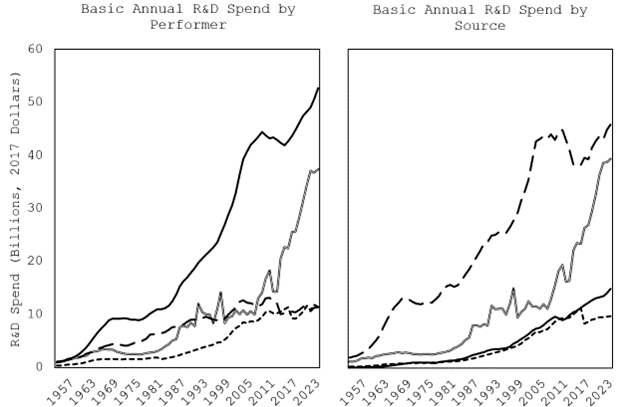

Figure 1: Private sector basic R&D has grown rapidly over the past two decades. It now rivals higher education among performers (left) and the Federal Government among funders (right) of basic research in the United States.15
This is not a sign that the academy has become less important, but rather that the scientific world has expanded. In certain domains, the scale of private investment dwarfs anything federal agencies can match. Universities face real limits in scaling up engineering efforts, with rare exceptions for government-sponsored big science projects like space probes and particle accelerators; yet Ph.D. students and professors can now raise hundreds of millions of dollars to found companies that pursue fundamental breakthroughs. Small startups increasingly perform basic research themselves, giving our most talented scientists new paths for ambitious work. These firms blur the distinction between basic and applied science, combining research and development to accelerate both.
The Linear Model No Longer Holds
In his 1945 report, Vannevar Bush presented a progression from basic research through applied research to development, later termed the “linear model.”16 This framework laid out a clear role for each part of the research and development pipeline. Universities would pursue fundamental understanding without the pressure of practical application. Industry would turn discoveries into products. At the time, the separation was natural and productive.
Modern discovery, however, is increasingly shaped by continuous iteration between fundamental and applied work. Engineering challenges routinely expose unanswered scientific questions, and breakthroughs in basic understanding, in turn, open new engineering pathways. The relationship is recursive rather than unidirectional. The tools required to push the frontier, whether advanced fabrication equipment or specialized engineering teams, are often found outside traditional academic settings. Many of our most productive researchers now move fluidly between sectors, carrying ideas and techniques with them. Technology and science have become deeply interdependent, even, as we will discuss in *Chapter V*, in the purest fields of reason like mathematics.
The task ahead is to enable scientists to move fluidly between problems of different shapes and to give them the freedom and resources to pursue discovery at today’s frontier.
This non-linearity is also captured by the framework Donald Stokes articulated half a century after Bush. “Pasteur’s quadrant,” as he termed it, now defines a growing share of the scientific frontier.17 Stokes argued that research can seek fundamental understanding while being motivated by considerations of use, observing that some of the most consequential scientific advances all arose precisely from this combination. Examples of such research include Pasteur’s investigations into why wine spoiled, the development of the transistor at Bell Labs, and Shannon’s work on information theory. Many of the transformative discoveries of our own era, from the computational study of protein folding that earned the 2024 Nobel Prize in Chemistry to the superconducting quantum devices that earned the 2025 Nobel Prize in Physics, emerged from efforts that were at once theoretically ambitious and deeply connected to practical problems.
Our national laboratories and federally funded research centers have long been engines for this use-inspired research, and new centers of modern science reflect the same pattern. A greater share of scientists are leaving academia for industry, not because they have abandoned curiosity-driven inquiry, but because the tools, resources, and career opportunities required to pursue certain fundamental questions increasingly lie outside university walls. The task ahead is to enable scientists to move fluidly between problems of different shapes and to give them the freedom and resources to pursue discovery at today’s frontier.
Our Researchers Face Mounting Challenges
These rapid changes demand that our institutions adapt. As will be addressed in Chapter II, significant portions of our federal funding apparatus remain anchored to outdated assumptions. This is not an indictment of the talented scientists and grantmakers who staff these bureaucracies, but a product of institutional inertia, born from the lack of market selection pressure that drives constant experimentation.
NSF, for instance, still organizes itself primarily around academic disciplines, much as it did in the 1950s, and channels resources overwhelmingly to a single type of performer, the university-based, principal investigator-led research group. Many federal programs are still built around the linear model, making the assumption that basic research happens in academia while development happens in industry. Academic incentives often penalize rather than reward partnerships that cross institutional boundaries. Agencies face little external pressure to adapt, even as the scientific landscape transforms around them, preserving processes essentially unchanged for decades.
Within academia itself, well-documented inefficiencies compound these structural problems. Administrative burdens on researchers have grown over time; one study found that investigators spend nearly half of their federally funded research time on paperwork rather than on research or teaching.18 Universities also extract significant overhead from researchers, which funds a mix of legitimate shared infrastructure and growing administrative bloat. Effective indirect cost rates at NIH-funded institutions average more than 40%,19 even though those same institutions frequently accept 10 to 15% overhead from private funders.20
The assumptions embedded in our federal grantmaking institutions, and the creeping inefficiencies within the universities they predominantly serve, reinforce one another. While researchers themselves recognize the need for renewal, few Administrations have had the will and mandate to pursue transformative change.
At a Time of Urgent Scientific Need
On the global stage, America no longer stands alone as the unchallenged leader in science and technology. The United States risks losing its first position to competitors that are quicker to update their models of research funding, maintain greater institutional flexibility, and can build tighter connections between different sectors of their scientific enterprise.
Over the past twenty years, China’s R&D spending has surged from a negligible fraction of U.S. levels to full parity on a purchasing-power-adjusted basis by some metrics (Figure 2). This is a situation America did not face even during the Cold War, when the Soviet Union’s economy was appreciably smaller than our own.21 Beyond the sheer scale of its spending, Beijing is treating scientific research capacity as a central pillar of global competition, elevating decision-making to the highest level and taking a tightly integrated approach to partnerships across its sectors. This all-of-society approach has allowed China to surge resources toward basic scientific research, advance rapidly in technologies of key national interest, and drive improvements in its innovation process, where entrenched interests have resisted change.
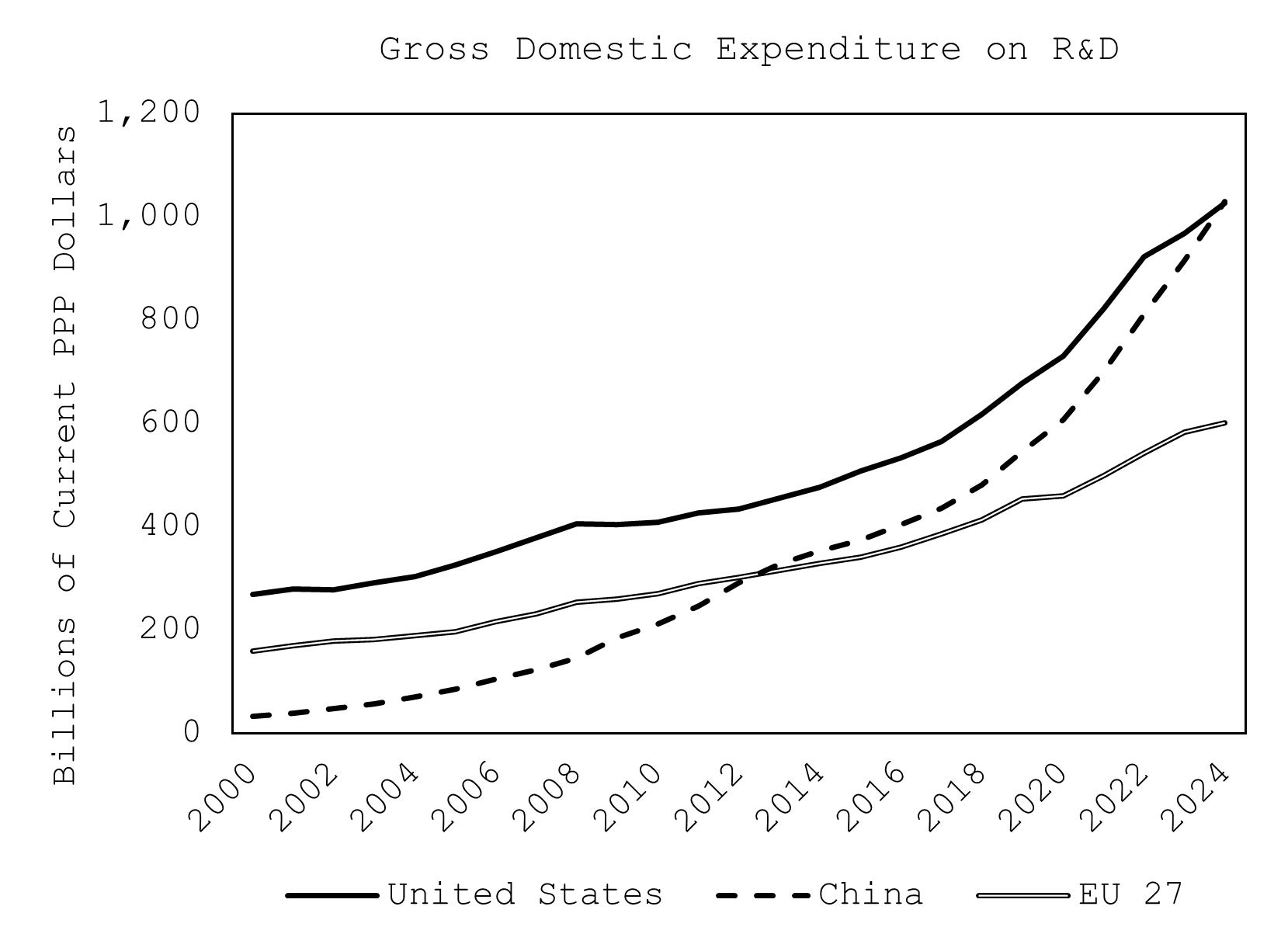
Figure 2: For the first time, the United States faces a peer-level competitor in R&D spending on a purchasing power parity (PPP)-adjusted basis.22
China is not the only country reforming its scientific enterprise. The United Kingdom, for example, has restructured its funding system to address internal inefficiencies, including creating a metascience unit to collect data and develop novel funding mechanisms. Norway has organized its national research council around a portfolio-based model, with boards that allocate funding across thematic priorities drawn from the government’s long-term research plan, alongside disciplinary portfolios. With new ideas bubbling up across the world and within our own vibrant philanthropic, metascience, and academic communities, it falls on the United States as the world’s premier scientific power to take a hard look at how we can accelerate our own scientific machine as well.
Regaining Leadership
Beyond strengthening science, we also have a duty to ensure that its downstream benefits accrue to the American people first.
For decades, the United States has funded large cohorts of foreign students and tolerated technology transfer abroad under lax security standards. As of 2024, temporary visa holders accounted for around half of U.S. doctoral graduates in computer science and mathematics with confirmed postgraduation plans.23 This reliance on foreign talent sidelines American students, a deep domestic talent pool that remains under-supported by its own government. At the same time, we train extraordinary global talent at enormous expense, only to lose this effort when foreign governments recruit them to build up their own technological enterprises. The interest of vast scores of Americans in using taxpayer dollars to invest in our STEM pipeline has, consequently, eroded.
America’s over-reliance on foreign students also creates a security challenge our institutions are ill-equipped to address. While our R&D ecosystem is now less vulnerable to exploitation due to Presidential actions taken in the first Trump Administration, there is an urgent need for a comprehensive approach to research security.24 Our competitors have learned to exploit a deep asymmetry between open and closed scientific systems, using our education system as an entry point into our innovation base while building domestic programs that undermine global scientific norms.
Beyond strengthening science, we also have a duty to ensure that its downstream benefits accrue to the American people first.
The United States conducts research openly, publishes freely, and shares methods transparently. These values are central to scientific progress. However, there is a critical difference between sharing information on one’s own terms and being exploited; the parts of a scientific enterprise that are not shared are often its comparative advantages. These are precisely what our competitors work hardest to extract, leveraging human capital educated in our universities, harvesting data from our papers while restricting access to their own, and scaling breakthroughs first achieved in our laboratories on their factory floors.
For too long, the United States has believed that technological leadership can be secured solely by the discoveries made in America, regardless of whether those discoveries are then translated into products, capabilities, and industries here or on foreign soil. The consequences of this unguarded openness, in laboratories and in markets, have been severe. The United States pioneered many key enabling technologies for Extreme Ultraviolet (EUV) lithography,25 yet the only company capable of manufacturing EUV lithography machines today is headquartered in Europe. We pioneered lithium-ion batteries, yet Asian firms dominate global supply chains, and by extension, battery chemistry research. We developed advanced manufacturing techniques that now underpin factories abroad. Discovery without domestic manufacturing leaves America paying the research bill while rivals develop the process improvements and capture the economic, strategic, and knowledge returns.
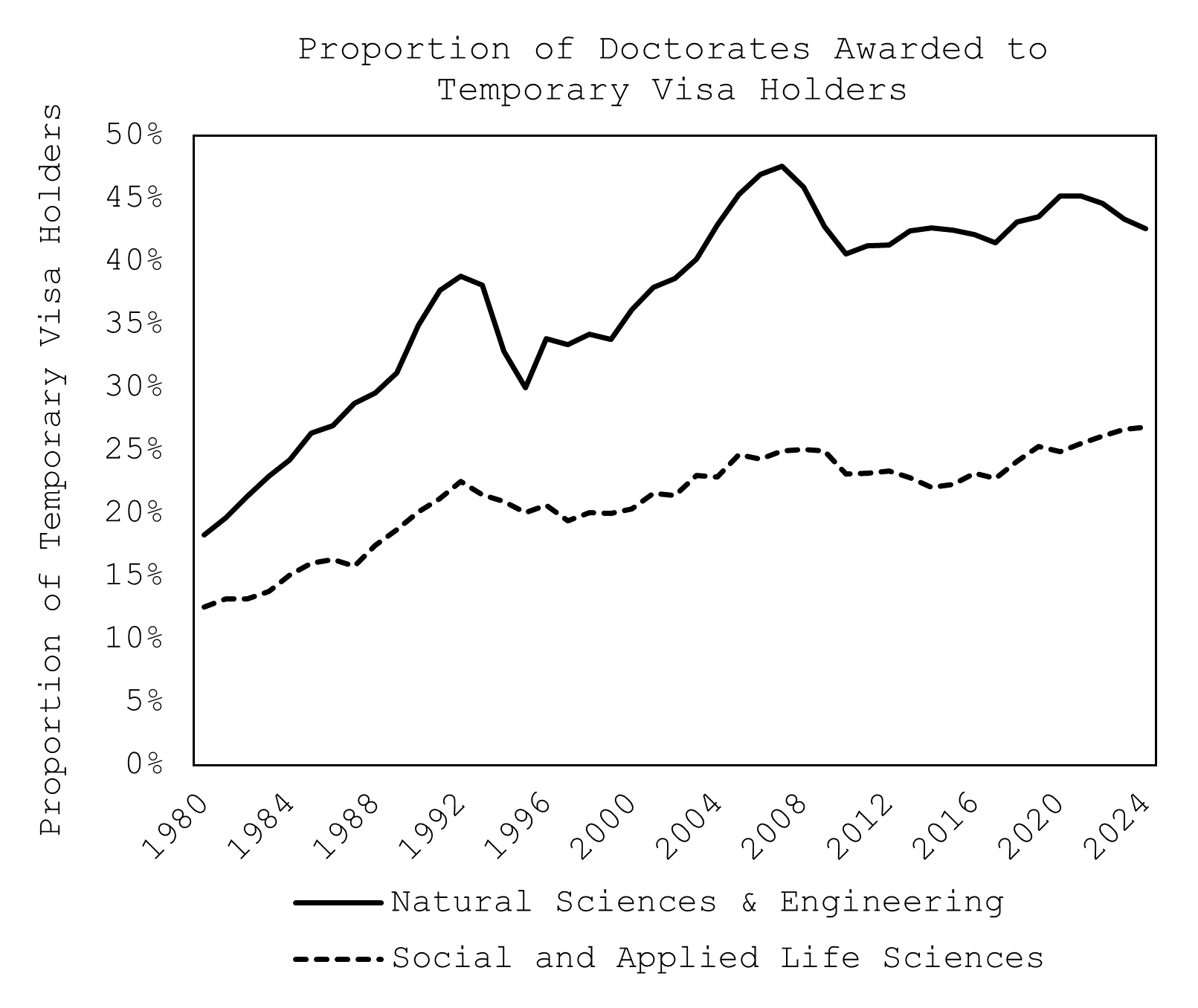
Figure 3: The share of U.S. doctorates awarded to temporary visa holders with definite postgraduation commitments has doubled over four decades, rising from roughly 20% to 40% in natural sciences and engineering, and from 10% to 20% in social, behavioral, and health sciences.26
The President's Charge
As our competitors copy and adapt our scientific machine for themselves, sustained leadership requires us to keep innovating. Standing still while the world changes is not stability. The Manhattan Project succeeded not only because of brilliant physicists, but because we built new institutions capable of coordinating the activity of thousands across the basic science and immense engineering challenges needed to build the bomb. The Apollo Program reached the Moon because NASA could marshal resources and talent in ways no university or company could match. Each represented not merely new funding, but fundamentally new ways of organizing scientific work.
We must face the reality that more innovation is happening in industry than ever before, and that the balance and nature of work shared across the federal, university, and corporate pillars of the national research enterprise have shifted. We must acknowledge, too, that the linear model of discovery and technical progress no longer holds. The interplay between basic research, regular professional science, and commercialization is far more complex than had been assumed. Meanwhile, the context in which the American innovation enterprise operates has become global, and therefore intensely vulnerable; the technologies we invent rely on production chains that stretch around the world, and they are subject to theft by near-peer competitors. Finally, the technological context in which science is conducted and shared has been radically transformed by the internet and current information technologies, now changing even more with the rise of AI.
Throughout our history, Americans have reinvented, reformed, and refounded our institutions when the moment demanded it. Each generation of American scientists, inventors, and pioneers has seized the opportunity to expand the frontiers of knowledge. On the occasion of America’s 250th anniversary, we must remember that ours is a Republic defined by courage, innovation, and exploration.
Just as scientific inquiry demands that we revise our theories when evidence contradicts them, evidence of scientific slowdown and serious competition from abroad should spur us to experiment with new systems, new models, and new ways of funding, conducting, and translating research. Vannevar Bush’s pioneering spirit calls us to do what he would surely do today: reimagine the entire enterprise for our time.
Revitalizing America's Science and Technology Enterprise
The Scientific Machine Is Getting Bogged Down
For the better part of a century, one of America’s most decisive advantages has been the ability to harvest novel discoveries for the prosperity of the American people. This advantage stemmed from the strength of our post-war innovation ecosystem: our universities, our national laboratories, and the symbiotic relationship between federal funding and research.
As Bush wrote in 1945:
A nation which depends upon others for its new basic scientific knowledge will be slow in its industrial progress and weak in its competitive position in world trade, regardless of its mechanical skill.27
However, our scientific dominance today is at risk. While our capacity to drive breakthroughs in basic science remains the envy of the world, as described in Chapter I, competitors are closing the gap. And while federally funded science continues to generate a high return on investment for our taxpayers, a growing body of work provides evidence that, across many fields, our researchers are fighting against an increasingly calcified system that has driven up the cost of scientific progress over time.28
Despite massive funding increases in biomedical research since the 1990s, the rate of significant breakthroughs appears to have slowed, drug approvals have flatlined, and the enterprise’s productivity, hampered by growing burdens, has declined.29 It has become common to speak of “Eroom’s law” (Moore’s law in reverse) describing the predictable decline in the number of new drugs approved per billion dollars spent. Since 1950, pharmaceutical R&D efficiency, as measured in new drugs per billion dollars, has fallen roughly eighty-fold in inflation-adjusted terms, halving approximately every nine years.30 And although the NIH’s budget has more than doubled since the 1990s, we have not seen a proportional increase in breakthrough treatments, citation impact per dollar spent, or scientific productivity.31
As a funder and institution-builder, the Federal government has fallen behind in creating environments where American scientists can do their best work. Evidence shows that the inputs required to sustain past rates of improvement have increased sharply across many fields. A famous study demonstrated that sustaining the historical pace of Moore‑style gains in transistor density has required a much larger workforce. Since the early 1970s, the number of researchers needed to double transistor density has risen more than eighteenfold, implying a 7% annual decline in “ideas productivity.” The pattern repeats in agriculture, where research effort has multiplied by factors of three to 25 since 1969, depending on the metric, while yield growth remains mostly flat; and in medicine, where the “years of life saved” per clinical trial peaked in the mid-1980s before falling sharply.32
Admittedly, slowdown in mature scientific subfields may be inevitable. One might argue that it is natural for the pace of progress to decline, once the proverbial low-hanging fruit has been picked. A slowdown could even be read as evidence of success. However, this intuition has repeatedly been proven wrong throughout modern history. And one would expect new mechanisms for sharing information, and new ways to compress scientific knowledge, to be countervailing forces that speed innovation.
The pattern of apparent stasis in a scientific field exploding into progress, opened by new discoveries and changes in scientific institutions, has repeated itself again and again. These punctuated equilibria are, in fact, the essential story of science. Max Planck famously had a professor tell him that physics was nearly as developed as mature fields like geometry, only for Planck’s own discoveries in quantum mechanics to completely reorient our understanding of the physical world. Many medical doctors believed their field was reaching perfection in the late 19th century, with one writing that “there cannot always be fresh fields for conquest by the knife.”33 Yet soon, the concurrent transformation of medical education and emergence of research hospitals created the institutional foundations for a broader understanding of disease and for modern medicine as we know it.34
Repeatedly, the tree has only looked bare from the current perspective; the fruits have not been exhausted at all. We had merely lacked the tools with which to pick them.
By adopting new social and material technologies, we can again accelerate the pace of discovery. It falls to us, as it fell to our predecessors, to imagine new machines capable of exploring the endless frontier.
Slowed by Growing Frictions
Our first step is to strip away the frictions that keep our brightest minds from pursuing the ideas most likely to lead to transformative breakthroughs. Consider a young scientist with a promising proposal for federally funded research, and the decades of accumulated institutional bureaucracy she must navigate to seek support in today’s enterprise.
She spends two to four months drafting the proposal, assembling preliminary data for the same project requiring funding, and navigating her university’s internal review process. If she applies to NIH in February, she will be lucky to learn whether she succeeded by the end of the year. Certain grants even have up to a 20-month lead time.35 That is almost as long as it took for the Boeing 747 “Jumbo Jet” to go from the drawing board to production.36
If she is awarded the grant, she will face mounds of paperwork. From 1991 to January 2025, the Federal Government imposed at least 270 new requirements on research grants, far outpacing efforts to reduce administrative burdens on researchers.37 Federally negotiated indirect cost rates now reach 50 to 60% of direct research costs at major institutions, a figure our scientist will have to bear in mind as she drafts her application.38 While effective rates often run closer to 40%, this remains a substantial tax on research budgets, shaping what she asks for. Some of this covers legitimate infrastructure she uses every day, but much of it funds administrative expansion at her university that has outpaced the growth of research itself.
Senior investigators can delegate paperwork to postdoctoral researchers, but our scientist runs a small lab and has no one to delegate to. She writes grant applications using hours that should have gone to experiments or mentoring students. This is a tax on innovation that does not appear in the federal budget but costs the nation dearly in foregone breakthroughs. These burdens also create a perverse incentive structure, in which scientists who excel at research administration leapfrog those who excel at research performance. The weight falls heaviest on the scientists America needs most.
The Incumbency Tax
The academy is a long and difficult road, leading to few stable positions. We should encourage early-career scientists at every step of the academic crucible, from undergraduate lab assistant to first faculty job, to pursue big and creative ideas. We should enable and empower scientists who persist into a research career to focus on breakthrough research from the start. But the data suggest we do not. Between 1980 and 2008, the average age of the NIH principal investigators rose from 39 to 51 (Figure 4), while the average age of new principal investigators rose from 36 to 42, exceeding the average age of Nobel Prize-winning contributions in related fields over a comparable period.39 These patterns lengthen feedback loops and bias careers toward safer, incremental projects during the long apprenticeship years. Our early-career scientist has seen this gradual graying of our research workforce, and is likely to adjust her ambitions accordingly.
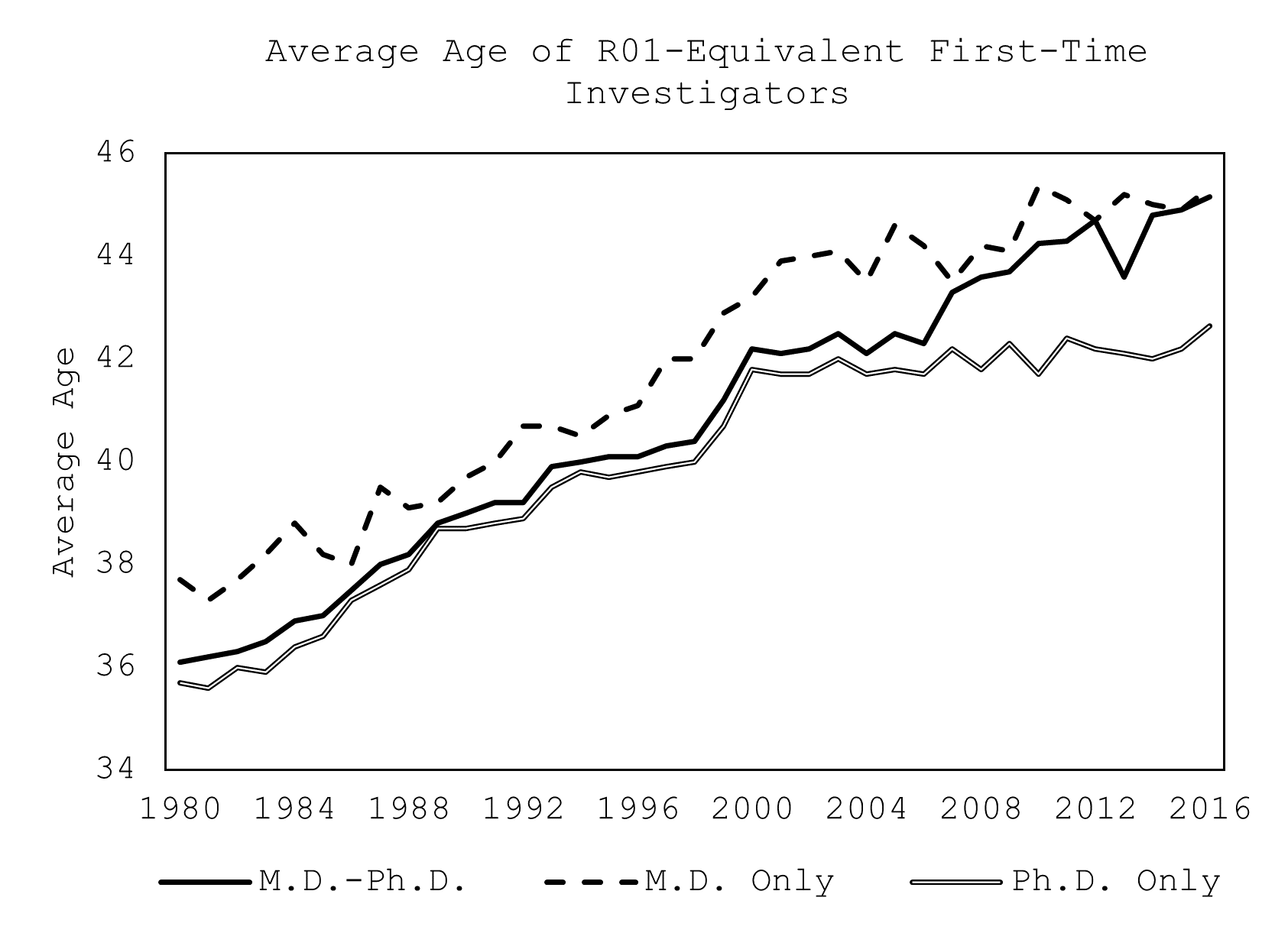
Figure 4: The average age of first-time NIH investigators has increased consistently over the past four decades, from mid-thirties in 1980 to the early forties today, across all degree types.40
The effect is encapsulated by Planck’s famous (mis)quote that “science advances one funeral at a time,” and is well documented.
Our scientist may accept that these longer training cycles reflect increasing specialization, but these incumbency dynamics also dampen turnover at the frontier. The effect is encapsulated by Planck’s famous (mis)quote that “science advances one funeral at a time,” and is well documented.41 Studies show that when a star scientist in biomedicine passes unexpectedly, outsider contributions surge into the space the star’s network has informally dominated, and those outsider papers are then more likely to become highly cited.42
At the system level, researchers find that as disciplinary fields grow large, attention ossifies around a fixed canon. New papers are less likely to displace central ideas, and even highly cited ones tend to receive citations in a burst rather than through steady accumulation.43
Weakened Meritocracy
Our up-and-coming scientist is further discouraged by the corrosion of the merit principle that once made American research the envy of the world. What began with the NSF’s “broader impacts” criterion, which was a reasonable effort to ensure taxpayer funds benefit society, has evolved into a sweeping distortion of the selection process that reduces mobility for the best researchers. Between 2021 and 2024, the share of new NSF grants focusing on diversity, equity, and inclusion initiatives surged from fractions of a percent to more than a quarter.44 Our scientist has learned the new rules from principal investigators she has worked for, and is tempted to dress up her otherwise excellent technical proposals with ideological language to survive review. Until recently, NASA required research proposals to include plans for furthering “inclusion goals,” which were to be reviewed by review panels one-half composed of “diversity, equity, and inclusion professionals.”45
The American scientific establishment has placed politics above merit and performance before. In the 1920s, elite universities implemented quotas limiting Jewish enrollment. Harvard’s president worried about a “Jewish problem” as Jewish students grew from 6% to 22% of the student body. The methods are strikingly familiar: subjective criteria for “character” and “leadership,” diversity requirements designed to recruit from regions with fewer Jewish residents, and “holistic” reviews that obscured the actual basis for decisions. These quotas, maintained for decades, excluded some of the most talented minds in American science.46
We should learn from this history rather than repeat it. When qualified candidates are passed over for reasons unrelated to their scientific ability, when they are judged for who they are rather than for their ideas, we injure the cause of progress, discovery, and America’s scientific competitiveness.
Misaligned Incentives
Even if the ambitious young scientist successfully navigates the selection gauntlet, she enters an academy whose incentives are severely misaligned with good scientific conduct.
Observing older peers, our scientist has learned that taking the long shot to challenge established paradigms may threaten her ability to deliver results and advance to tenure; yet by the time she achieves tenure, a substantial portion of her most creative years will be behind her. She notices, too, that the tenure and promotion system seems to reward quantity over quality. Cutting work into the smallest publishable units, which researchers call “salami-slicing,” often pays off more than making an ambitious attempt at transformative discovery.
Our scientist knows a better way is possible. Private-sector laboratories and startups routinely give young researchers tremendous responsibility, and there they are afforded the opportunity to change the world. Research shows that when investigators receive longer-horizon support with tolerance for early failure, they produce portfolios with both more hits and more misses, the signature of genuine exploration.47 But project-tied, short-cycle grants dominate the federal landscape, and our scientist feels pushed toward safer, more “fundable” territories. These incentives also help explain why her peers now commonly reach professional independence only in their forties, not their early thirties as in previous generations.
The publication economy amplifies these problems. The young scientist quickly learns that there is a particular narrative pattern common to all articles published in the top journals. Meta-research has documented a structural reduction in novelty in papers and patents, which are less disruptive and less likely to reorient a field than in prior decades.48 Scientists eschew negative results, even though failed experiments often teach more than successes. Competitive environments amplify this positive-results bias, crowding out careful negative findings and tool-building that lack tidy narratives. Because the system pays by the paper, it under-invests in public goods like datasets, open-source code, and shared engineering infrastructure. The team science now required at the technological frontier gets abandoned for work that generates individual credit.
The Reproducibility Crisis
As many leaders in American science agree, the research enterprise must learn to value and incentivize reproducibility studies and to hold its members responsible for failures in the scientific process.
The reproducibility crisis, particularly acute in the social sciences, has undermined future research and public confidence. In one study that attempted to reproduce 100 psychology studies, fewer than 40 succeeded.49 The challenge extends across other fields as well. In Alzheimer’s research, a celebrated 2009 paper in a top journal presented a promising path to treating the disease.50 By 2012, other researchers had demonstrated its irreproducibility, and internal reviews at the sponsoring pharmaceutical company terminated drug development based on its findings.51 Yet the paper accumulated more than 800 citations, misdirecting research priorities and federal funding for another decade.52 Its lead author became a university president, and the paper was only finally retracted 15 years after publication, shortly after the lead author resigned amid a broader investigation into data manipulation in his laboratories.53 The scientific review process worked, eventually, but far too late.
As many leaders in American science agree, the research enterprise must learn to value and incentivize reproducibility studies and to hold its members responsible for failures in the scientific process.
The good scientist knows that knowledge is probabilistic, that evidence accumulates gradually, and that uncertainty is inherent. But the system pressures researchers to deliver results in confident, discrete units. Journal editors want clear narratives. University press offices demand headlines. Nuance dies, as a result, in the race for attention.
This failure has spilled over to political decision-making. With notable and still-undercelebrated exceptions, the scientific establishment during the COVID-19 pandemic failed to recognize that science can only describe the world as it is, not the world that ought to be; while it informs policymakers, it cannot determine the best policy, or the tradeoffs that should be made. The scientific consensus to shutter schools demonstrated a profound inability to confront uncertainty or integrate knowledge across specializations. The best available evidence indicated that children were neither at high risk of the disease nor significant vectors of transmission. Conversely, the developmental costs of remote schooling and isolation were entirely predictable. Yet, scientific officialdom produced a “closed-ranks” response, preferring blind consensus over informed dissent. The scientific consensus failed to check its own work, communicate the limits of its own certainty, or remain skeptical of its own assumptions.
And A Lack of Accountability
Even as our individual scientists continue to do world-changing work, performing miracles that save American lives and defend our homeland, these challenges reflect a systematic breakdown in the lines of accountability that align the scientific enterprise with the public interest.
While repeating the mantra that science must be “independent” of politics, parts of academia have become highly dependent on government funding. But as Bush understood, federal support for science must be politically accountable. Accountability does not mean dictating how a research agenda is to be executed, nor turning away from the basic research that has long been the wellspring of American prosperity. Quite the opposite. It means ensuring that the system serves the researchers who are its lifeblood, rather than the entrenched interests that have accreted around them. Only those parts of the national research enterprise directly responsive to the political process can prioritize among the many potential avenues of inquiry, fund those that best reflect national priorities, and be checked when the scientific process breaks down. In a self-governing nation of laws and citizens, the Federal Government elected by the people shall have the ability to determine how to allocate public resources in the public interest.
Within that framework, the independent role of federally funded scientists is to design and execute the research and experimentation program that achieves those objectives. A properly accountable system is one that protects their freedom to do so.
Originally intended to shield researchers from external political meddling, the invocation of “scientific autonomy” has too often been inverted. Autonomy, and indeed America’s culture of intellectual freedom, remains one of our most valuable scientific assets, but it has been cynically used as a shield against accountability, as scientific institutions are slow to police themselves, or even engage in political meddling of their own, often at the expense of our brightest and most energetic minds. The same scientists who receive grants often serve as the reviewers who dispense them, enforcing a consensus that perpetuates existing biases. Federal funding agencies, in particular, lack the feedback mechanisms found in the private sector. In venture capital or philanthropy, poor judgment faces the swift discipline of the market; bad bets lead to insolvency. In the federal sphere, absent deliberate action, there is no penalty for rejecting a breakthrough, nor for funding safe work that changes nothing.
A Better Path Forward
One necessary step in restoring accountability to federally supported science is exercising better oversight of scientific funding so that research activities align with the best interests of the American people, through the intentional and principled allocation of capital.
Our federal agencies distribute approximately $200 billion in annual R&D funding. Yet we have no systematic framework for identifying where those dollars could catalyze the greatest scientific returns, with deference instead given to the same incumbents that consume the funding. This process produces a portfolio that emerges by accident rather than intentional design.
Driving meaningful improvements in our portfolio allocation will require a coordinated effort, but it is not impossible. We already have proof that bold models can dramatically accelerate progress and deliver new scientific opportunities for our researchers.
Throughout history, Americans have developed various ways to support scientific progress that depart from the university-based, principal investigator-driven grant. These include Cold Spring Harbor Laboratory, a leading institution of biological research, founded in 1890, and the Institute for Advanced Study, founded in 1930, which gave luminaries like Einstein, Noether, Oppenheimer, and Gödel an opportunity to explore revolutionary ideas. Each provided a home for new kinds of science.
Another famous example is DARPA, which gave us GPS, the internet, stealth aircraft, and autonomous vehicles. Rather than relying on consensus-based review panels as the primary decision-making mechanism, DARPA gives individual program managers the power to make bold technological bets and actively curate teams to execute them. Congress has taken notice, creating the Advanced Research Projects Agency for Health (ARPA-H), Advanced Research Projects Agency–Energy (ARPA-E), and other similar agencies, collectively representing billions of dollars organized around the program-manager model rather than traditional peer review.
Over the past decade, a growing community of researchers, philanthropists, and policymakers has turned the lens of scientific inquiry onto science itself, asking precisely how we can reduce frictions, align incentives, increase accountability, and inject more dynamism into the scientific enterprise. This field, often called metascience or the “science of science,” has begun generating rigorous evidence of what actually works, both by studying why models like DARPA or the Institute for Advanced Study succeed, and by running controlled experiments on new approaches.
Philanthropies and federal agencies are now deliberately applying these insights and piloting new organizational forms to address gaps the traditional academic system cannot fill. For instance, the NIH has recently created a metascience office, and the new Directorate for Technology, Innovation and Partnerships (TIP) within the NSF has begun experimenting with alternatives to traditional peer review, designing and executing controlled experiments in alternative funding mechanisms in partnership with metascience researchers.54
These scattered successes confirm the possibility of systematically redesigning how we organize, fund, and conduct science. Realizing that potential will require us to understand how the nature of scientific work has changed, what new institutional forms those changes demand, and what funding mechanisms can best support them.
The answers will not come from any single reform but from building the capacity for continuous experimentation, for applying the scientific method to the scientific enterprise itself.
Adapting to the Changing Nature of Science
The 19th and 20th centuries witnessed a series of institutional innovations that ushered in a fertile era of discovery. The natural philosophy of earlier ages, where a single scholar might range freely across what we now call physics, chemistry, and biology, had given way to specialized disciplines. Each had its own departments, journals, and staff. This transformation, pioneered primarily in German universities during the 19th century, laid the foundation for scientific professionalization.55
America adopted this architecture of discovery and gave it a distinctive twist. Land-grant universities democratized access to scientific education, the college major system restructured undergraduate training, and technical universities focused on industry. These innovations proved remarkably successful. The combination of disciplinary depth with clear career ladders enabled the specialization that carried us into the scientific lead.
Yet the disciplinary framework that served us in the 20th century sits uneasily with science in the 21st. The most consequential questions of our era, such as how proteins fold and function, how certain disorders emerge from neural circuits, and how we can harness fusion energy, do not respect departmental boundaries.
The protein folding problem that earned the 2024 Nobel Prize in Chemistry belonged to no single academic department; it required deep knowledge of biochemistry alongside advances in AI and engineering at scale.56 Two of the three laureates came from a corporate research lab where team-based science harnessed diverse expertise. The third laureate’s work was seeded by NSF and later heavily supported by private philanthropy, spinning off into a large-scale, university-affiliated center.57 Both efforts depended on decades of infrastructure building and open science, such as the Critical Assessment of Structure Prediction competitions and the Protein Data Bank, built by over 60,000 experimentalists who shared their findings freely.58
America adopted this architecture of discovery and gave it a distinctive twist.
The shape of an institution determines the shape of the science it produces.59 The university laboratory, centered on the principal investigator and a rotating cast of graduate students, excels at curiosity-driven research and at training the next generation within established disciplines. The industrial R&D lab, with its permanent staff and tight feedback loops, is suited to engineering projects.60 The national laboratory and large-scale, multinational scientific projects maintain unique capabilities too large for any single actor to sustain. Each form is a container that dictates what research becomes possible and what research never gets attempted.
A growing share of scientific problems now demands containers that do not yet exist at scale in the federal portfolio, and does not yield immediate products that contribute to a company’s bottom line.61 Mapping the wiring of the mammalian brain, for example, requires not a student on a three-year cycle, but a sustained engineering team with the flexibility to scale quickly and hire from industry. It necessitates industrial-scale data collection and analysis, which is infeasible under the fragmented structure of traditional academic grants. It produces a public good whose benefits a single biotechnology company cannot fully internalize.
This pattern extends across other key problems. Achieving practical fusion energy depends on progress in plasma physics, materials science, advanced manufacturing, and systems engineering, paired with the ability to scale up through venture funding. Understanding cognition well enough to address mental disease will benefit from new neural recording probes, machine learning suites that analyze neural activity patterns, and systems that deliver precise, closed-loop therapeutic interventions. Creating new institutional forms, then, plays a central role in bringing new scientific projects to life.
The standard NIH R01 grant, which typically offers a quarter of a million dollars a year for a pre-specified project, is the workhorse of American biomedical research. It excels at supporting hypothesis-driven science by small teams on tractable questions. But over-reliance on this structure creates systematic blind spots. Projects requiring tens of millions of dollars and a team of dozens fall outside the container of what any single investigator can assemble. Academic containers are further shaped by labor availability. Employing postdocs and graduate students remains effective for training the next generation of scientists, but doing so is poorly suited for executing large-scale, mission-driven programs that require continuity, specialization, and long-term institutional memory. Frequent turnover fragments efforts and slows progress. As science funders have noted, no technology company would entrust its core R&D to a workforce composed primarily of temporary trainees, yet this is the standard model in academic research.62 A more balanced approach would expand stable, well-compensated career paths for staff scientists, engineers, and technicians, roles critical to sustained institutional capability.
Through Novel Performers
Between the atomized work of the individual investigator and billion-dollar mega-projects like particle colliders lies a vast middle ground of mid-scale science. These are scientific problems requiring tens of millions of dollars, coordinated teams of ten to a hundred people, and timelines of half a decade. They range from the development of minimally invasive brain-computer interfaces that help people with Parkinson’s to the building of new platforms that decode immune memory. Such projects, which are often infrastructure-heavy, engineering-intensive, and cross-disciplinary, are challenging to perform in principal investigator-led academic labs. They are rarely pursued in industry either. Pharmaceutical companies face much stronger incentives to chase the next drug breakthrough than to build platform technologies for decoding basic biology.63
The ARPA model has proven so effective because it fills precisely this gap in mid-scale technology development. By offering grants in the tens of millions of dollars, these agencies can assemble new research teams and help startups tackle ambitious engineering challenges, from robotic satellite servicing to AI-equipped fighter jets.
Funding at this scale, which has worked well in incubating new technological capabilities, could be extended to basic science as well, where the government is not merely procuring a weapons system, but pursuing scientific advancement for the national interest.
Among private funders, a new class of focused research organizations, or “FROs,” has started to fill the gap. FROs are time-bound, nonprofit research startups, engineered to break specific scientific bottlenecks. They hire professional engineers and career scientists, building institutional memory instead of just cycling graduate students through their training process. They produce public goods like open datasets, platforms, and tools, rather than the proprietary intellectual property that defines the commercial startup. And unlike the national laboratory, which is built to last indefinitely, the FRO is built to dissolve, pursuing a well-defined technical milestone and winding down once the mission is complete. These organizations can set long time horizon milestones to target specific bottlenecks and provide full salary support, removing the grant-writing treadmill.64 The time-limited nature also gives scientists who complete the project a chance to return to academia, or to spin off a startup and raise venture capital.
| Activity | University | Corporate Lab | Federal Lab | New Institutions |
|---|---|---|---|---|
| Curiosity-driven, investigator-led research | ● | ○ | ◐ | By design |
| Larger-scale, engineering-intensive science | ○ | ◐ | ◐ | By design |
| Long-horizon platform and tool development | ○ | ◐ | ● | By design |
| Public-goods data and infrastructure development | ◐ | ○ | ◐ | By design |
| Mission-driven, public-good science | ◐ | ○ | ◐ | By design |
| Proprietary product development | ○ | ● | ○ | By design |
| Workforce training and apprenticeship | ● | ◐ | ○ | By design |
● Well-Suited ◐ Partially-Suited ○ Less-Suited
Table 1: Established institutional forms, such as universities, corporate laboratories, and federal laboratories, each carry their own relative advantages. Future modes of organization should be designed to fill the scientific gaps our existing institutions miss.
The FRO model acts as an open call for new kinds of science, and for ideas our researchers have rarely dared to pursue thus far because there are no avenues for them. Academic incentives filter out team-based execution; commercial incentives filter out public goods; national laboratories filter out the agility to hire flexibly and execute rapidly. The FRO occupies the new ground of problems too large for the standard federal grant, too non-commercial for venture capital, and too risky and fast-moving for government facilities.
But the FRO is just one point in a broader design space (Table 1). As the examples of Cold Spring Harbor Laboratory and the Institute for Advanced Study illustrate, many other approaches are possible. One proposal taxonomizes a range of novel institutional structures, including minimally constrained homes for basic science, FRO-style teams that execute against specific bottlenecks, and specific formats focused on the scouting and seed-funding of non-consensus ideas.65 Others have written about the variables that together map out the design space: the timeline over which projects are expected to pay off, the revenue strategy, the intellectual property policy, the size of the team, and the use of clear market signals to drive problem selection, among others.66
Betting exclusively on the existing funding model is like building a military composed entirely of infantry, effective for one kind of warfare, inadequate for others.
Fortunately, there are ways to expand the scope of federal grantmaking to support these innovations. The NIH and the NSF possess OTA that allows them to bypass traditional grant constraints. Our national laboratories can also create pathways to stand up flexible, federally supported scientific teams on time-bound missions. Recently, NSF’s TIP Directorate launched the X-Labs, the first federal program explicitly designed to fund independent research organizations outside of traditional academic institutions. X-Labs will provide full-time teams of researchers, scientists, and engineers with operational autonomy and milestone-based funding as they pursue technical breakthroughs. These teams will not only produce traditional research outputs like publications and datasets, but also command the resources and financial runway to develop revolutionary platform technologies that unlock new fields of scientific inquiry.
NSF’s X-Labs represents a proof of concept for what federal science funding can become. Consider the mammalian brain mapping example again: one of neuroscience’s grand challenges. A federally supported initiative could draw from extensive public-private partnerships, leverage matching grants from America’s vibrant philanthropic sector, and bring the best researchers from academia together to develop moonshot infrastructure that scales connectome mapping, much as the Human Genome Project commoditized genetic sequencing. A hypothetical X-Lab could help map the reward and motivation circuits across various small mammals, producing one-of-a-kind datasets. For medicine, these circuit diagrams would offer a way to map the circuitry implicated in depression, addiction, and autism. For AI, they would provide a biological reference architecture for building more robust systems, drawn from natural structures that keep impulses in check and align short-term behavior with long-term goals.67
New Mechanisms
Reformed and new scientific institutions should also be matched with a broader menu of improved selection mechanisms for determining who and what type of organization receives scientific funding. Just as some organizations are better suited to certain kinds of scientific projects than others, so too are some selection processes better than others at identifying and motivating promising talent and programs.
The economic field of mechanism design, recognized with the 2007 Nobel Prize, provides the theoretical foundation for understanding how rules shape behavior and outcomes. Mechanism design can be thought of as asking the inverse of traditional economics. Given a desired outcome, what incentives and institutions will produce it? The field has already transformed how we allocate spectrum licenses, match medical residents to hospitals, and price internet advertising. Science funding is an equally rich domain for applying the field’s tools.
At its core, our challenge is that scientific research involves private information that funders cannot directly observe. Peer review emerged as one solution to this information problem, but while peer review has a long and time-honored history of distinguishing good science from bad, it struggles to distinguish the exceptional from the merely good. Furthermore, reliability is low, and multiple reviewers rating the same NIH proposal frequently reach contradictory conclusions about the credibility of the science.68 These structural flaws only get worse as the number of proposals rises. When a funding agency can support only one proposal in ten, the noise begins to drown out the signal. All too often, consensus-driven panels fund the least divisive ideas rather than the most promising.
While these problems are widely recognized, reform has been slow because the incentives are asymmetric. A failed experiment invites Congressional scrutiny, whereas continuing the mediocre status quo draws little attention. The review panel thus serves as a convenient liability shield, allowing decisions to be attributed to “the scientific community” rather than to any individual who might be held accountable. A mechanism designed to hedge risk ends up precluding the risk-taking that breakthrough science requires.
But evidence from recent experiments suggests that modifications to funding mechanisms can yield substantial gains in both efficiency and scientific output.
Better Grantmaking
One approach is to improve how peer review functions. In Denmark, a private foundation has experimented with a “golden ticket” system that allows individual reviewers to champion unconventional proposals lacking consensus support.69 This model helps rescue high-risk breakthroughs that colleagues might reject, and it is supported by a double-blind process that removes career history, cutting against elitism and leveling the playing field for younger or less prominent researchers.70 The approach also tends to attract higher-quality reviewers, who are individually empowered to make bold scientific bets.
The NSF has begun piloting golden tickets under its TIP Directorate, and opportunities exist for broader adoption across new federal extramural funding agencies.71
Another approach is to change what we fund, supporting people over projects. Using philanthropic money, the Howard Hughes Medical Institute (HHMI) has provided long-horizon support in roughly $10 million over seven years with minimal reporting requirements, while tolerating early failure and betting on people rather than on project proposals.72 When researchers compared these grantees against similarly accomplished federally funded scientists, they found that the privately supported investigators, who have been granted more academic freedom, produced high-impact publications at nearly double the rate of their peers and were far more likely to explore genuinely novel lines of inquiry.73
Since 1952, the NSF GRFP has directly funded some of America’s most promising incoming doctoral students.
Similar approaches have been tried in federal agencies, but remain too small a share of the current portfolio. The NIH’s own Director’s Pioneer Award, designed to emulate the HHMI program, shows comparable results,74 and the NSF’s CAREER award, though smaller in grant size, has also produced countless breakthroughs. The same philosophy of betting on individuals can be used to support younger researchers as well. Since 1952, the NSF GRFP has directly funded some of America’s most promising incoming doctoral students. While more work remains to improve the selection mechanism and further empower students to choose their universities and principal investigators, such an approach has shown significant promise. The fellowship provides three years of support with full portability across institutions, freeing recipients to follow intellectual opportunity. The results speak for themselves: more than 40 GRFP alumni have gone on to become Nobel laureates.75
These long-time-horizon grants can be matched with fast grants that provide flexibility on shorter timescales. NSF has mechanisms for fast decision-making that bypass external review panels, but they remain underutilized and often behind schedule. Meanwhile, a privately funded American program has demonstrated that, without any significant sacrifice to scientific quality, funding decisions can be made effectively in 48 hours rather than 6 to 9 months, with applications that take 30 minutes, rather than months, to prepare.76 Scaling these just-in-time grants up within federal grantmaking agencies could encourage more risk-taking on novel ideas, all while reducing administrative burdens.
Prize Challenges
Pull mechanisms offer another powerful and underutilized alternative to traditional funding, aligning incentives around outcomes rather than inputs. Traditional grants pay for effort, such as researcher time, equipment, and supplies, regardless of whether the project succeeds. Pull mechanisms invert this logic by paying for results.
The case for pull mechanisms is strongest when the goal is clear, but the path to it is not. The most famous example is the DARPA Grand Challenge for autonomous vehicles, which catalyzed an entire industry. DOE and ARPA-E have also used similar prize authorities to accelerate breakthroughs in energy storage and grid technology.77 A related mechanism is the advanced market commitment, which guarantees a market for a scientific or technical capability before a product exists.
Such approaches can generate massive investment leverage. A privately funded prize for suborbital spaceflight offered $10 million but triggered hundreds of millions in combined research and development spending across competing teams.78 Similarly, the open structure of another prize competition attracted solvers from unconventional backgrounds to read the unopenable Herculaneum scrolls, a feat eventually accomplished not by seasoned archaeologists but by a trio of computer science and robotics students.79 While these mechanisms are ill-suited for open-ended, curiosity-driven research, they can be powerful tools for incentivizing use-inspired research and supporting technology commercialization. An optimal innovation portfolio requires both push mechanisms to explore unknown territory and pull mechanisms to close identified gaps.
Future Ideas
The list of examples go on. Some of these mechanisms already exist in our federal portfolio and should be used more, others should be experimented with, and still others have yet to be invented. Each addresses different aspects of the same underlying challenge. Each represents a hypothesis about how to elicit honest signals, reward productive risk-taking, and allocate resources where they will generate the greatest return.
One emerging idea, for instance, is to decentralize decisions. Doing so can leverage the wisdom of crowds to identify good science. Scouts, financially rewarded to find promising projects and individuals, could help identify scientific research for grantmakers. At a larger scale, the “regranting” model rests on the observation that the people best positioned to spot breakthrough opportunities often lack the authority to fund them, while those with the authority lack information to spot them. Regranting bridges this gap, delegating funding allocation to researchers or experts who possess the specific judgment to identify promising work before consensus forms.
Existing intermediaries already perform this function with philanthropic funding. Such a model could be extended by funding portfolio-based regranting organizations through federal agencies, or by giving a broad range of scientists the ability to regrant a small check to anyone other than those in their own academic institutions.
More speculative mechanisms, such as quadratic funding, remain in early testing.80 This approach weights the breadth of support more heavily than depth. A proposal backed by many small contributions receives larger matching funds than one backed by a few large donors. Quadratic funding reveals community preferences rather than gatekeeper preferences, and has shown promise in open-source software, though evidence of its application to science remains pending.
There must ultimately be a menu of options from which those who exercise federal funding authority can choose. The current selection system concentrates decisions among too few people using mechanisms that cannot support the weight placed on them. We stand at the beginning of a renaissance in grantmaking, and the Federal Government should welcome this experimentation.
A Portfolio-Based Approach
Private capital allocators must deliver results or risk losing their investors. Philanthropies compete for donor confidence. But federal program officers receive little corrective feedback when their grant portfolios systematically underperform, and agencies rarely compare outcomes across funding mechanisms or allocation strategies.
Just as investment funds in the private sector balance their portfolios and match mechanisms to the nature of the work, we need to move toward a far more intentional approach to grantmaking. The preceding pages cataloged a diverse arsenal of mechanisms: golden tickets, which move us beyond false consensus; individual-based funding, which bets on researchers rather than proposals; pull mechanisms, which pay for outcomes rather than inputs; and regranting, which delegates decisions to those closest to the frontier. Each works for certain problems, operates well within certain institutional constraints, and produces returns with a particular risk profile.
Science is not a pure random walk; it often helps to have an inductive bias.
We can also be intentional about where we place various programs on the exploration-exploitation trade-off. Bold scientific bets can pay off in big ways; the biggest breakthroughs of the past decades have more often than not been driven by a relentless pursuit of tools and frameworks to answer practical questions. Science is not a pure random walk; it often helps to have an inductive bias. This is Pasteur’s quadrant, the domain of use-inspired basic research, which we discussed in Chapter I. But pure curiosity-driven research can also deliver immense value to society. Riemann’s abstract study of differential geometry eventually enabled Einstein’s formulation of general relativity; the field of group theory eventually enabled cryptographic codes, computer graphics, and our understanding of elementary particle physics.
The key lies in distinguishing between cases where strategic direction can accelerate progress, and cases where the fog is too thick for anything but an exploratory search.
Intentional grantmaking therefore requires deliberate portfolio construction: a mix of high-risk and low-risk bets; a balance of person-based, project-based, and institution-based funding; and explicit strategies for allocating across fields and capability areas. Federal agencies should construct their portfolios the way sophisticated allocators do, with thesis-driven conviction about where breakthroughs are most likely to emerge, while preserving space for the serendipity that no thesis can anticipate. We should aim to engineer a large, well-constructed portfolio that allows us to win in the long run.
To Drive Constant Innovation
The foundation of this portfolio should be a metascience unit in each federal science agency. Each unit should be highly empowered, reporting directly to the director or administrator to ensure cross-agency visibility and guard against capture by particular programs or constituencies. Each unit should be staffed with researchers possessing expertise in the science of science, program evaluation, and data analysis, supplemented by rotating program officers who bring operational knowledge of how grants actually get made.
Federal funding agencies should develop systematic gap-mapping capacity, regularly review their funding portfolios, and drive more intentional grantmaking instead of deferring to the portfolio allocation of the previous fiscal year. Such a process could identify both bottlenecks and the foundational capabilities that would address them.81 Metascience units could, for instance, convene expert workshops and maintain living maps of capability gaps, or work externally with foundations that have developed sophisticated methods for identifying transformative research opportunities. DARPA’s Heilmeier Catechism embodies this discipline, forcing explicit articulation of what gap a program addresses and why solving it matters.82
These units should also be empowered to do more than advise on the existing portfolio of instruments; they should pilot new ones across agency programs. An NIH unit might randomize whether study sections use golden tickets, then track the novelty and citation impact of funded projects across conditions. An NSF unit might compare outcomes from fast grants against standard review timelines. A DOW unit might experiment with how much discretion program managers are given in funding decisions, comparing data across branches. Without the authority to run experiments and to compel program offices to participate, these units will devolve into compliance operations producing reports. One way to secure this authority is to give each metascience unit a budget it can regrant to program managers for participating in experiments. Their findings should also be published externally, building the broader evidence base on what works in science funding and creating accountability to act on what is learned. The United Kingdom’s Metascience Unit, established in 2024, offers an early model, reporting in its first year on distributed peer review, partial randomization of awards, and the consistency of reviewer judgments.83
All this institutional experimentation must be matched by hiring the highest quality staff.
We can, and must, make program management one of the most sought-after jobs in science, where talented people can shape the direction of entire fields. DARPA’s success rests not on any single mechanism but on hiring the right program managers and giving them genuine discretion. This begins with making it easier for people from a wide range of backgrounds, including industry and philanthropy, to enter a short stint in government, and with raising the prestige and profile of program officers, whose efforts in coordinating entire fields toward major breakthroughs often go underrecognized. We need to recruit the best scientific talent into these roles, and then truly empower them, with resources, freedom, and the opportunity to network with the smartest people tackling the hardest problems.
America invented the modern research architecture with institutional innovations that the rest of the world subsequently adopted. We must lead the charge again.
Ensuring U.S. Dominance in Critical and Emerging Technologies
We Must Choose Our Technological Future
In centuries past, land and population determined national power. The Industrial Age added capital and manufacturing capacity as fundamental components of national sovereignty and security. As the President’s National Security Strategy makes clear, technological capability has always conferred advantages, and now sets the terms on which all of these inputs operate.84
Technological leadership helped forge modern America. Science alone did not produce this leadership; it required the deliberate cultivation of engineering talent, institutional capacity, and industrial might to turn discoveries into capabilities. Our physicists translated Schrödinger’s equations into the weapons that ended World War II and defined the nuclear order that followed. Our engineers turned Shannon’s information theory into the protocols that carry the world’s digital communications. Our scientists turned advances in physics and materials science into GPS satellites that guide ships, planes, and precision weapons on every continent.
Technology has become foundational to a nation’s economic and military strength, its capacity to act independently in the world, and its ability to maintain its distinct culture and way of life. American technological leadership produced enormous wealth, secured our homeland, and turned our nation into a beacon for the rest of the world. It cannot be taken for granted.
The nature of technological advantage is shifting. As will be discussed in Chapter V, advances in AI expand the world’s ability to generate ideas and will accelerate scientific research. These capabilities will benefit American scientists. But those benefits will also accrue to our competitors. As new tools of discovery become more widely available, the comparative advantage conferred by scientific excellence alone will likely narrow. It will therefore be equally important for our nation to bolster its capabilities in translation, the process turning ideas into real-world capabilities. That is the subject of this chapter.
Failure of the Passive Model
America has long been the world’s most prolific source of scientific breakthroughs. We must ensure we are equally formidable at turning those breakthroughs into national power, or we risk watching the fruits of American discovery harvested first by others.
For decades, American science and technology policy rested on an unspoken assumption that government need only fund basic research, support a vibrant economy, and trust that technological strength would follow. Pour money into universities, protect intellectual property, keep markets open, and the innovations that secure the nation and enrich its people arrive on schedule—this was the implicit bargain of the post-war scientific order, and for a generation it appeared to work.
That laissez-faire assumption does not survive contact with competitors who have built technological states. Commerce and research now constitute a geopolitical battlespace, and the parallel to trade policy is instructive. For decades, the United States assumed that open markets would naturally produce American prosperity and that free trade would lift all boats by maximizing global efficiency. Instead, unilateral openness hollowed out the American industrial base. Competitors exploited our markets while protecting their own. The gains from trade accrued to a narrow slice of the economy while entire communities lost their livelihoods. President Trump has delivered a necessary correction, recognizing that economic security is national security.
The same logic applies to science and technology. The assumption that federal research investment alone would sustain American technological dominance has proven naive. We funded the discoveries, trained the researchers, and published the papers, but did not ensure that the benefits accrued to our nation. The ideas, as well as the time- and resource-intensive parts of the development cycle, are taken abroad to benefit others.
American researchers invented the flat-panel display; Asian manufacturers captured the market. American scientists pioneered cutting-edge battery chemistries; production scaled overseas. The pattern has repeated across decades and industries. The cause was the same passive model that hollowed out our factories, while our competitors pursued a holistic strategy that deliberately blurred the line between public and private, civilian and military, treating every advance, wherever it originated, as raw material for their state-directed development.
Choosing to Lead
Our nation’s technological outcomes are shaped by policy choices. The internet became an American platform because we embedded openness and competition into its foundations. We chose to go to the Moon in 1969 because of our national will. It is an achievement that appears, in retrospect, jarringly out of place in humanity’s technological timeline. Conversely, nuclear energy stalled in America not because the physics failed, but because regulatory choices over the past half-century made building uneconomical.
In each case, the decisive variable was the set of institutional, regulatory, and strategic choices that determined whether science became capability. Competition may dictate that nations will adopt AI, race from genotype to phenotype, pursue nuclear technology, and build advanced warships, but it does not dictate how they go about it, or even necessarily when. Within broad technological trajectories, multiple futures are possible. The question is which one America will fight for.85
Conversely, nuclear energy stalled in America not because the physics failed, but because regulatory choices over the past half-century made building uneconomical.
Fighting in Our Own Arena
No nation, however powerful, can lead in every domain. Some technologies demand that we press forward, extending strengths into durable advantages where early leads compound over time. Others require that we hold ground. We may not seek total dominance, but we will not permit an adversary to achieve it either. In domains of lesser strategic consequence, we can concentrate our energies elsewhere and ensure that strengths accrue to partners, rather than adversaries.
The technologies that matter most are those that form platforms on which future technologies are built. Dominating the right foundational platforms grants structural power, allowing the leading actor to dictate the rules and standards by which others must play. These advantages compound, with advances in one field, like computation, unlocking breakthroughs in others, like AI and biotechnology, creating feedback loops that reinforce the leader’s edge.86
The semiconductor industry offers one striking example. It was not predetermined by nature that transistor density would increase exponentially over time, as described by Moore’s Law. Rather, the market found ways to harness, fund, and develop the miracles of physics and material science that made such exponential growth possible. In turn, the countries that control the semiconductor supply chain now push a snowball that gets bigger every year, incorporating more and more of the modern economy. Mobile communications, satellite navigation, and ever-more powerful AI systems are all built on this platform.
Winning does not mean isolation. Yes, sovereignty over critical technologies often means building the capacity to produce them domestically. But as the semiconductor example illustrates, technological leadership can also mean strategic integration, supplying the platforms that drive economic growth across our partners’ economies, like tapping into broader markets to push the snowball of Moore’s Law. Leadership means charting our own destiny by choosing which technologies we develop, which standards we set, and which supply chains we control, rather than accepting a world shaped by the choices of others.
Accomplishing those goals requires that we understand and amplify our true advantages. Among our competitors, some, despite their industrial strength, lavishly fund state priorities while leaving private markets to languish, missing breakthrough technologies that emerge from the fringes. Their economies remain investment-driven rather than productivity-driven, with total factor productivity contributions declining even as R&D spending rises. And while the success of their consumer applications is often mistaken for genuine R&D-intensive innovation, they remain far behind the United States in driving original frontier research.87
Meanwhile, America’s financial architecture channels capital toward frontier technology at a scale no nation can rival. In 2024, American venture capital firms deployed over $200 billion, accounting for 57% of global venture investment.88 Our public markets tell an even more striking story. As the time of writing, the seven largest American technology companies are collectively worth more than the entire stock market of our primary competitor. These figures reflect not just deep pools of capital, but liquid markets that reward successful exits, a legal system that enforces contracts and protects property rights, institutional investors with long time horizons, and a startup ecosystem that treats failure as education rather than disgrace.
This is our arena. The task before us is to match the incredible vibrancy of our markets with our scientific capital, to unleash technological capabilities that benefit the American people.
Unleashing Innovation
Over the past few decades, America has built a regulatory state that brings down a gavel to block much innovation in the physical world. When it takes longer to obtain a permit than to build the thing being permitted, when the default answer from the government is “no” or “wait,” the most talented builders go elsewhere or stop trying. This system selects against the kind of people and organizations that drive innovation, namely small teams, unconventional entrants, and entrepreneurs whose opportunity costs are so high that they will not wait years for approval.
The nuclear industry illustrates the problem at its most extreme. The United States once led the world in nuclear technology. We built the reactors, trained the engineers, and wrote the safety standards that other nations adopted. Then we regulated the industry into paralysis. Before an advanced reactor startup can pour a single foundation, it must spend five to six years in pre-application discussions with the Nuclear Regulatory Commission (NRC), followed by a design certification process that can take an additional four years. One company had to submit a 12,000-page application, supported by more than 2,000,000 pages of technical documentation. DOE spent over $600 million in funding to support this process for a single reactor design. Then came the combined license application, with its own multi-year safety and environmental reviews, mandatory public hearings, and construction inspections.89
The Freedom to Build
The first Trump Administration began to fix this regulatory morass in the nuclear realm, supporting bipartisan legislation to reform the NRC’s approach.90 In the second Administration, we have moved to break the logjam entirely because the stakes are so high, driven by energy demands across America’s AI and manufacturing industries.
In May 2025, the President signed four executive orders overhauling America’s nuclear regulatory framework: imposing an 18-month deadline for the NRC to revise its regulations, capping licensing timelines for new construction applications, creating expedited approval pathways for reactors already tested by the DOE or DOW, and directing the NRC to weigh the benefits of nuclear energy to economic and national security in its regulatory decisions. Companion orders direct the DOE to facilitate five gigawatts of power uprates to existing reactors, begin construction on ten new large reactors by 2030, and invoke Defense Production Act authority to secure domestic nuclear fuel supply chains. These are the most sweeping nuclear reforms in a generation, taking down the old system that placed the status quo above the American people.91
In biotechnology, the United States pioneered many of the foundational advances in genomics, gene therapy, and CRISPR-based medicine, yet our clinical trial system has grown so costly that testing American discoveries increasingly happens abroad. A promising retinal prosthesis that restores vision for the blind, developed in Alameda, California, had to run its clinical trials in Europe due to challenges navigating the approval process.92 Per-patient costs for clinical trials run far higher than in other economies; American scientists make the breakthroughs, but the infrastructure to validate and deploy them is migrating overseas.93
The best of American innovation has always been characterized by permissionless experimentation, the freedom to build, test, fail, and try again without asking leave at every step.
Here, we have also begun to reverse the trend. The U.S. Department of Health and Human Services (HHS) has launched the largest deregulatory effort in the Department’s history. The Food and Drug Administration (FDA) has moved to accept real-world evidence in regulatory reviews,94 dropped the default requirement of two clinical trials per drug application in favor of a single well-powered study with confirmatory evidence,95 and fast-tracked review timelines for drugs supporting U.S. national interests. The NIH introduced a new site to make the community aware of priority scientific areas without the need for new Notices of Funding opportunities and also eliminated application requirements that added burden without commensurate benefit. 96 These reforms are essential, and they must mark the start of a sustained effort to ensure that the world’s most innovative biomedical science is tested and deployed on American soil.97
These examples should only be the beginning. The best of American innovation has always been characterized by permissionless experimentation, the freedom to build, test, fail, and try again without asking leave at every step.
A permissionless approach to innovation does not mean the reckless development of technology. Prudence in broad deployment is wise, and it is the foundation of society’s trust in our technologies. But policymakers must also price in the harms of stagnation: the economic growth foregone, the lives lost waiting for a cure, the industrial and automotive accidents that happen by failing to adopt more advanced technology. Where existing rules do not fit new technologies, regulatory sandboxes that allow real-world testing under controlled conditions can generate the evidence needed to write sensible ones. Our goal should be to dismantle the procedural obstacles that prevent American knowledge from becoming American technology, while maintaining genuine accountability for results.
Matched With the Places to Test
About 70 years ago, a committed group of amateur rocketeers purchased a private test site in the Mojave Desert north of Edwards Air Force Base. Since then, the oldest continuously operating amateur rocket group in the country has been firing homemade engines. In 2003, a spin-off organization incorporated next door as a nonprofit, and its volunteers built the necessary infrastructure from scratch. They erected static test stands, reinforced concrete blockhouses, and propellant storage sites. They secured federal permits for handling high explosives and a Federal Aviation Administration (FAA) waiver to launch rockets to 40,000 feet on weekends. A reservation there costs anywhere from a few hundred dollars to the low thousands.98
On any given Saturday, at this facility, a father-and-daughter team working out of their garage may be standing next to university engineering students and off-duty aerospace professionals, all firing liquid engines in the open desert. The adjacent airport itself became an FAA-licensed commercial spaceport in 2004.99 Multiple rocket companies have emerged from this cluster of cheap leases, federal licenses, and shared test infrastructure to win NASA prizes, raise substantial venture capital, and reshape the commercial launch industry.100 Mentors at the amateur site were recruited into startups. Startup veterans returned to mentor the next cohort of rocket enthusiasts. These organizations have overcome the odds in one of the most heavily regulated industries in America and have bred a vibrant ecosystem for innovation.
Today, the Federal Government also offers test stands at industrial scale through the Stennis Space Center, where startups can lease facilities rather than spending tens of millions of dollars building their own.101
Providing test infrastructure and sustaining a regulatory environment that allows our innovators to experiment represents one of the most important levers we have for driving technology forward.
Test infrastructure, whether for rockets, advanced manufacturing, autonomous systems, or any frontier technology, is an enabling resource that determines whether the next great American company starts in a desert lot or dies on the vine in a student’s garage. Wherever AI systems are deployed at scale, wherever advanced reactors are built and operated, wherever synthetic biology is used in agriculture and medicine, the resulting standards, supply chains, and knowledge bases will compound in favor of the nation that moved first. America must be the place where that experimentation happens.
While bright spots like the Mojave site and the Stennis Space Center exist for particular industries, across much of America, the gauntlet between a scientific discovery and a deployed technology has grown so forbidding that many of our best ideas never make it through. Too often, ideas die after the paper is published. A breakthrough in a university laboratory must be prototyped, tested under real-world conditions, validated against safety and performance standards, manufactured at scale, and brought to market. The most talented builders increasingly migrate toward software, where the regulatory burden is lightest. This contributes to the lopsided economic growth we see today, away from the world of atoms in our heartlands, and toward the world of bits in the Valley.
Opening America's Laboratories
Beyond test beds, America possesses extraordinary research infrastructure, built up over decades of federal investment. The DOE alone operates 28 user facilities, from the Advanced Photon Source at Argonne to the Spallation Neutron Source at Oak Ridge, providing capabilities available nowhere else on Earth.102 These facilities represent billions of dollars in capital investment by the American taxpayer and decades of accumulated expertise.
Yet access to this extraordinary infrastructure has historically been too narrow and too slow. Echoing a theme from Chapter II, evaluations for facility access are built for academic merit review. This system works for university scientists pursuing publications, but fails entrepreneurs who need to validate technology on a timeline set by competitors.
Opening these facilities more broadly to private industry, with evaluations that weigh innovative potential and commercial urgency alongside scientific merit, would multiply the return on existing federal investments. An older culture at the labs holds that industry engagement detracts from the research mission, but in reality these interactions benefit both sides, allowing external users to leverage the lab’s vast knowledge base while exposing lab researchers to new use-inspired problems. Revenue from user fees can also fund expanded capacity and new instrumentation, turning facilities that today operate below capacity into self-sustaining engines of innovation. Every facility-hour that goes unused is a wasted national asset; every dollar of industry revenue reinvested is a dollar of federal appropriation freed to grow the next generation of tools and equipment.
Large federal facilities are only part of the picture. Closer to the entrepreneur, shared platforms at smaller scales have proven equally transformative. The National Quantum and Nanotechnology Infrastructure program provides shared cleanroom access with more than 2,000 available tools, enabling startups to prototype semiconductor, photonics, and quantum devices without building their own fabrication lines, often at the cost of just a few hundred dollars per hour.103 In the life sciences, shared wet laboratories have reduced the capital barriers for early-stage biotech companies, enabling researchers to move from concept to experiment in weeks rather than the years required to build a dedicated facility.104 Shared Good Manufacturing Practice (GMP) facilities address an even larger bottleneck.105 The production of clinical-grade materials under FDA-compliant conditions requires tens of millions of dollars in capital investment that most startups cannot raise before they have clinical data. This has created a catch-22 that can be broken by shared GMP platforms. Expanding these platforms across sectors and geographies would put the physical tools of innovation within reach of any American entrepreneur with a good idea.
Our national laboratories and universities can play a similar role at larger scales, serving as revitalized hubs of testing and evaluation for private industry. Places like Oak Ridge, Sandia, and Lawrence Livermore possess unique capabilities to validate technologies no startup could test alone; universities that host startups in their research infrastructure catalyze knowledge and hiring pipelines that multiply innovation. Yet licensing and partnership processes at national labs remain slow relative to the pace at which technologies must move. American research universities face a parallel challenge. Intellectual property policies vary wildly across institutions, creating friction for companies that want to license from multiple universities. Faculty incentive structures typically reward publications over commercialization, and far too often, equipment purchased with federal grants sits idle between projects while entrepreneurs who could use it have no access.
Reforms that streamline university technology licensing, standardize IP frameworks for federally funded research, and open university facilities to outside innovators on flexible terms would unlock a vast reservoir of capability that today remains bottled up behind administrative walls. Likewise, streamlining the CRADAs that govern lab-industry partnerships, further leveraging the OTA, and reducing the administrative burden on companies seeking to license lab technologies, would help our scientific institutions move closer to industry speed.
Tapping Our Private Sector
A major task ahead for the Federal Government is to harmonize the efforts of our publicly-funded institutions with our dynamic private sector. The way government funds science has not yet fully integrated the spectacular rise of the private sector in both basic and applied R&D. In the 1960s, the Federal Government funded over 70% of all basic research performed in the United States.106 Today the federal share of basic research funding has fallen to 40%, while industry’s share has grown to well over 35%. Our biggest technology companies and leading pharmaceutical firms now support or directly publish some of the most cited work in fundamental science. Individual technology companies now spend more on R&D than the NSF’s entire annual budget. In fields like AI, quantum computing, and advanced drug discovery, the most important research increasingly requires capabilities that universities alone cannot provide.
In AI, the companies that train frontier models wield supercomputers worth tens of billions of dollars, hold petabytes of proprietary data, and can afford to spend tens of millions to recruit the best engineering talent in ways no university can match. This has produced an academic brain drain; yet academic researchers remain essential to the long-term health of the field, producing foundational work on next-generation algorithms that companies have less incentive to pursue. Without new partnership structures that give academic scientists access to frontier-scale resources, the basic research that underpins the next generation of AI advances will atrophy, and our technological leadership will rest on an increasingly narrow institutional base. What is needed are mechanisms that adequately leverage the comparative advantage of both public and private funding.
The way government funds science has not yet fully integrated the spectacular rise of the private sector in both basic and applied R&D.
Closer Partnerships
As a first step, we need to expand the scope of Federal grantmaking. Funding should be open to new types of institutions, whether they are joint industry-university centers or independent research organizations that can raise equity.
Some mechanisms already exist but are underused. As discussed in Chapter II, the OTA can surmount procurement constraints, and institution-agnostic grants can reach nonprofits, industry consortia, and independent researchers. SBIR and STTR programs can be deployed strategically to advance new scientific and technological capabilities, coupling federally-seeded companies with the scientific enterprise. Furthermore, our science agencies could establish or strengthen agency-adjacent independent foundations, modeled on the Foundation for the NIH (FNIH).107 One FNIH public-private partnership involving NIH and industry partners, the Accelerating Medicines Partnership (AMP), invests in reducing the timeline to find live-saving therapies and improvements in outcomes. The AMP on Alzheimer’s Disease, one of twelve disease-focused AMPs, experimentally validated 20 candidate drug targets to lead to clinical trial success.108 Such foundations can blend public and private capital in ways that federal procurement rules prohibit, contract on commercial terms, and accept cost-sharing from industry partners, offering a vehicle for public-private collaboration that moves at the speed of industry while remaining responsive to policy priorities.
The most powerful conduit between institutions, however, is the flow of human capital itself. Industry Ph.D. programs that enable American citizens to complete doctoral training at leading private organizations or national laboratories would offer higher stipends, real work experience, and exposure to problems at the frontier while also drawing a larger proportion of American citizens into basic research. Such programs already exist in prototype.109 These include industry postdocs, where some of our best researchers join leading companies to drive groundbreaking work, and industry-funded Ph.D. scholarships, which create revolving doors that bring new ideas into our strongest mathematics and physics departments. Programs like Activate at Lawrence Berkeley National Laboratory embed entrepreneurial scientists in national lab environments with stipends, lab access, and mentorship, and have been effectively expanded to talent emerging from the nation’s universities through investments by NSF.110
We can build on these models by creating more flexible cross-institutional talent pathways. Scaling such programs would widen the aperture for our researchers. Instead of being locked into a single institutional track, or forced into a risky, one-way jump into industry, our next generation should be able to move fluidly among a wide range of sectors, institutions, and research cultures.
Marshaling Grand Efforts
Reforming the bilateral partnership between our government and private companies is only the first step. Many of the most transformative technological achievements in history required the deliberate marshaling of national effort toward goals that no single company, university, or agency could achieve alone.
The Human Genome Project is a case in point. It began as a federally directed NIH-DOE partnership in 1990, with initial funding in President Reagan’s 1988 budget submission.111 Its creators wagered that a complete reference of the human genome, and the sequencing technology advanced through the effort, would become a foundational technology for all of biomedicine. Its advocates pressed forward even as many leading biologists in the late 1980s dismissed the project as immature and argued the money would be better spent on individual grants.
Only the Federal Government could have marshaled the coalition that executed it. A distributed network of DOE national laboratories and NIH-funded centers, including Washington University and the Whitehead Institute, coalesced around common milestones and operated under the Bermuda Principles, which required immediate public data release. The project depended on the productive entanglement of public and private capacities, most notably in the development of new automated capillary sequencers, where federal demand pulled forward private innovation in instrumentation.112 When Celera Genomics entered as a private competitor in 1998, the resulting public-private dynamic accelerated the timeline further. The project finished ahead of schedule, and the $3.8 billion federal investment has generated an estimated $796 billion in economic activity.113
The human genome story exemplifies the Federal Government driving American leadership in a platform technology. It featured an engineering challenge bound up with a basic science mission; a gap in basic capabilities that could be closed through large-scale coordination; and a network of national laboratories and academic institutions focused on a common goal. Its completion required public-private collaboration that broke institutional walls.
Pre-Competitive Consortia
The Federal Government wields enormous power to align fragmented actors around shared objectives. As discussed in Chapter II, well-designed grand challenges exemplify this convening power for problems with clear metrics and deadlines, where opening the field to outsiders is an advantage. But not all shared problems lend themselves to this approach. Some technical challenges sit between basic science and commercial application, too applied for academic grants and too risky for any single firm to tackle alone.
These pre-competitive problems, shared across an industry, require another instrument: cooperative R&D anchored by federal investment.
SEMATECH is the defining American example. By the 1980s, Japanese manufacturers had captured the majority of the global memory chip market. In 1987, fourteen American semiconductor companies pooled resources, matched by federal funding through DARPA, to attack shared manufacturing challenges in lithography, etching, and materials processing.114 The consortium solved technical problems that every American chipmaker needed but none could afford to solve individually.
The consortium solved technical problems that every American chipmaker needed but none could afford to solve individually.
The SEMATECH model produced an even more consequential successor. In 1997, EUV LLC, another semiconductor consortium, contracted with three DOE national laboratories to develop EUV lithography, a technology that required breakthroughs in plasma physics, precision optics, and materials science beyond the reach of any single firm. By 2001, the consortium had built the first prototype EUV exposure tool and filed over 150 patents.115 Refined over the following two decades, that technology now underpins every leading-edge semiconductor manufactured on Earth. While policies undertaken then ceded the dominant market position to a European company, EUV lithography remains one of the most strategically important industrial technologies in our part of the century, and it exists because American federal laboratories and semiconductor companies solved the problem together.116
The pre-competitive consortium model worked because it targeted the right problems where the science was understood, but the engineering had not yet been done, where shared technical risk was the barrier. Today, many challenges of a similar scale and complexity await, such as returning leading-edge semiconductor research to American soil, programming biological tissues with precision, and creating next-generation nanotechnology techniques that allow for self-replication and atomic-level manipulation. No single firm can tackle these problems, traditional academic grants cannot fund them, and the nation cannot afford to leave them to chance.
The Federal Government’s ability to anchor such ventures, leveraging private capital, aligning fragmented actors, and sustaining effort over timelines that no quarterly earnings cycle would tolerate, remains one of its most potent and underutilized capacities.
Our National Character
Alexis de Tocqueville observed nearly two centuries ago of America that “boldness of enterprise is the foremost cause of its rapid progress, its strength, and its greatness.” He marveled at a society where social station was not fixed by birth, where citizens formed voluntary associations to solve problems rather than waiting for direction from above, and where the frontier, both physical and intellectual, beckoned those willing to take risks.117 That culture persists. Americans believe that merit deserves an opportunity to show itself, that free inquiry produces truth, and that individuals who build useful things deserve reward.
That spirit is alive in our states and cities. America’s federal system affords us the chance to run many experiments simultaneously across jurisdictions, creating regulatory testbeds, distinct infrastructure, and tailored incentives. By letting companies operate robotaxis on public roads years before most states had written their rules, Arizona built itself into the nation’s leading testbed for autonomous vehicles.118 It has further leveraged that permissive environment to attract over $100 billion in semiconductor investment.119 Utah passed the nation’s first general regulatory sandbox in 2021.120 Wyoming enacted a series of laws tailored to blockchain and digital asset companies.121 States and cities that get regulatory frameworks right attract capital, talent, and industry; those that do not learn from those that do.
When our researchers recognized that scaling laws would transform language models, no government committee approved the decision to pursue it. When our engineers concluded that reusable rockets were possible, a deregulated space industry emerged that mobilized massive capital to land rocket stages. This pattern, of creating a vast reserve of scientific talent and knowledge, of permissionless innovation backed by patient capital and enabled by regulatory flexibility, represents America’s great competitive advantage.
But in an era of foundational technologies and active rival states, permissionless innovation must be married to strategic purpose. The capacities described in this chapter, especially the ability to discover and test, to move from laboratory to demonstrated viability, are the mechanisms by which American boldness becomes American dominance. The Federal Government should actively encourage experimentation at every level, creating the conditions for more states, more cities, and more institutions to become laboratories. In a competition where early experimentation locks in trajectories, the nation running the most experiments holds the advantage. For more than 250 years, going back to 13 separate colonies, that has been the American way.
Ensuring That Science and Technology Better the Lives of All Americans
The Marriage of Science and Craft
In policy conversations, we often speak as though technology consists solely of intellectual property and gadgets. We focus on the patents that can be filed, the knowledge that can be written down, or the complex machines that can be built. But scientific and technological capability consists of much more than its most visible inputs and outputs.
A better taxonomy holds that technology exists in three forms: tools, explicit instructions, and process knowledge.122 Consider chipmaking. The tools are the lithography machines, etchers, implanters, and more. The explicit instructions are the blueprints and recipes. But the process knowledge, like how to troubleshoot semiconductor yields, how complex variables affect wafer cleaning, how the next process node should be designed to balance performance and manufacturing risk, lives in the heads of experienced engineers and technicians.
This tacit knowledge cannot be fully codified. Anyone can be placed in front of a piano bench with a score of Rachmaninoff, but playing it well requires a personal command of musical dynamics and tactile skill.
As the chemist-turned-philosopher Michael Polanyi observed, “we can know more than we can tell.”123 A skilled welder knows things about metal behavior that no manual captures, like the way aluminum warns you before it warps, or the sound a good bead makes as it forms. A machinist develops intuitions about cutting tools that come only from years at the lathe. A pharmaceutical manufacturing technician recognizes subtle variations in chemical processes that determine whether a drug batch meets specifications.
This process knowledge, embodied in an experienced workforce, is the true keystone of technological capability.
The same applies to the practice of science. When the sociologist Harry Collins studied laboratories attempting to replicate a new type of laser in the 1970s, he found that no scientist succeeded using published sources alone. Those who built working devices had all spent time in a laboratory with someone who had already done it. The knowledge to build the laser flowed through personal contact, often so subtle that scientists themselves could not fully articulate what they had learned.124
Likewise, a synthetic biologist improves through countless failed experiments while coaxing cells into expressing a novel protein. An immunologist, after years of experience and guidance from senior mentors, develops intuitions for which protocols will work with finicky cell lines, knowledge no methods section can capture. This is why many forms of scientific expertise require years of on-the-job training in working research organizations, and why academic publications alone remain insufficient to transmit the craft of science.
Papers and patents are not the ultimate ends of progress, but way stations in the training of better scientists, engineers, and technicians. Science is not simply about the equipment, which any laboratory with enough capital can purchase, nor the instructions, which can be shared on a sheet of paper.125 Our true competitive advantage lies in the process knowledge embodied by America’s talent. Without skilled practitioners who pass their craft to those who follow, the engine stalls.
Our Manufacturing Base
America has endured a sustained period of deindustrialization. Manufacturing employment peaked at nearly 20 million workers in 1979;126 today it stands at roughly 13 million, a decline of around 35%, even as the population has grown by more than 50%.127 Manufacturing’s share of total employment fell from nearly 22% in 1979 to around 8% today.128 This sustained decline has been compounded by the offshoring of contract research and development, especially in the pharmaceutical industry, where laboratories have moved abroad en masse. The fate of the American scientific enterprise is inseparable from the fate of American industry for two reasons.
First, most of the economic returns from scientific discovery arise not at the moment of invention, but during the translation of new ideas into products that can be produced at scale. The returns lie in the work that follows invention: the engineering that makes designs manufacturable, the process refinements that bring costs down, the skilled workforce that operates advanced facilities, the supply chain relationships that enable scale. When technological translation moves abroad, so do the jobs, the expertise, and the capacity to produce the next generation of breakthroughs.
Second, science and production continually inform one another. As discussed in Chapter I, the linear model in which basic research flows neatly to applied research, development, and production has always been a simplification. Knowledge circulates not only between the theorist and the experimentalist, but between the experimentalist and the industrial sector as well. The scientist studying semiconductor physics learns from the manufacturing engineer wrestling with yields. The biologist designing a new therapeutic depends on the process chemist who can scale production. The roboticist developing a high-torque actuator benefits from the presence of a local precision manufacturing base, working where he can drive down the street to stand beside a machinist at the turning center to optimize the design in person.
These feedback loops depend on proximity between scientific research and industrial capability. Without local manufacturing capacity, the marriage of science and craft weakens. Scientists lose access to the practical problems that inspire new lines of inquiry and improve research quality, while industry loses the research ecosystem that sustains technological leadership. We need to reshore American manufacturing, not only for the sake of fruitful employment, but for the long-term health of American science itself.
Vast Potential Remains Untapped
Even after decades of offshoring, the United States still nurtures some of the most dynamic trade communities in the world. Ours is a nation of tinkerers, hobbyists, and people who fix things with their hands. Countless Americans learn to repair cars from family members, to operate power tools, and to build and maintain their own homes. From barn raisings on the frontier to hot rod culture in the 20th century to today’s maker movement, this do-it-yourself (DIY) spirit runs deep in our culture.
More than half of American adults participate in some form of making or building activity.
Log onto any video sharing platform and you will find a country of builders. Amateur machinists demonstrate techniques for precision manufacturing. Hobbyist welders share tips on joining titanium. Electronics enthusiasts repair broken oscilloscopes. Amateur radio operators, biohackers, synthesizer builders, and drone constructors all participate in communities of shared technical knowledge. Even highly specialized pursuits such as nuclear fusion and cyclotron construction have attracted dedicated experimenters. Public libraries increasingly offer 3D printers and laser cutters, while local shops provide courses in welding and machining.
This grassroots engagement with technical work points to a vast reservoir of talent waiting to be cultivated. More than half of American adults participate in some form of making or building activity.129 The largest DIY conventions have attracted more than a hundred thousand participants.130 Manufacturing employment may have declined, but the cultural foundations of technical skill remain in the same population from which we once drew machinists, toolmakers, and engineers.
As Our Educational System Tilted the Scales
Yet our formal educational and employment systems often fail to develop this potential. Over the past several decades, the expansion of college education has come at the expense of vocational training, and high schools that once taught machining classes have shifted resources toward college preparation. As factories closed and communities hollowed out, the message to young people that working with your hands is a fallback, not a calling, was clear. Success meant escaping physical work, not mastering it.
This cultural shift was reinforced by an economic transformation that treated physical labor as a commodity to be sourced wherever it was cheapest. This prejudice runs deep. In too many communities, politicians and guidance counselors have come to treat trade schools as consolation prizes for those not cut out for a four-year degree. Over the past two decades, shop class equipment from shuttered programs has flooded the used machinery market, tangible evidence of how thoroughly we abandoned hands-on education in our rush toward a so-called knowledge economy.131
The costs are now visible on both sides of the ledger. Millions of Americans have the aptitude and interest for technical work, but lack clear pathways to translate that interest into careers. Meanwhile, millions of skilled jobs are expected to be unfilled even as graduates enter the workforce.132 For decades, the Federal Government tilted the scales against career education by extending unlimited loans to students attending colleges, universities, and graduate programs, driving up the cost of college and burying millions in debt.133 At the root of this policy failure was the government’s inability to recognize that the work of building, maintaining, and repairing the physical world is not a relic of the past, but the foundation of any future prosperity.
We Must Restructure Science as a Broader Endeavor
Too many of our universities and elite science and technology curricula have severed the connection between theory and craft. Engineering students study the theory of combustion, but few can disassemble and rebuild a combustion engine. Graduate programs reward theoretical contributions measured in citation counts, but not practical applications measured in jobs and dollars. The result is a generation of researchers who can model phenomena mathematically but cannot repair the apparatus in their own laboratories.
This narrowing departs from how science actually advances. As discussed in Chapter I, the linear model no longer holds in many fields, where discovery increasingly relies on feedback from the real world. Some of the most important breakthroughs in molecular biology and theoretical physics have come from scientists who understood their instruments intimately, who could not only design the experiments but build and modify the equipment themselves.
Consider Rainer Weiss, who won the 2017 Nobel Prize in Physics for detecting gravitational waves. Weiss grew up scavenging war surplus electronics in New York, teaching himself to build ham radio transmitters and fixing broken devices for pocket money. After flunking out of MIT, he took a job as a laboratory technician, working alongside veteran craftsmen, learning to machine, solder, and weld.
It was this training in what Weiss called “the art of improvisation in experimental science” that enabled him to design and build the prototype laser interferometer that became LIGO, the instrument that detected ripples in spacetime from colliding black holes a billion light-years away. As Weiss put it, “I’m a big believer in what’s called the apprentice system.”134
The divorce between scientific training and craft has held back America’s scientific progress. The tacit knowledge that powers our scientific enterprise, developed through experimental practice and hands-on technical training, will only become more important. The particle accelerators at our national laboratories need electrical engineers who can develop more powerful klystrons; fusion experiments need vacuum specialists and fabricators who can work with tungsten; telescopes that map the universe need craftsmen who grind mirrors to nanometer precision. These are the people who may well be core contributors to the next technological breakthrough. We must give STEM students at every level of study the opportunity for hands-on technical training, and conversely, ensure America’s skilled technical workforce has clear pathways to participate in formal academic training and scientific research. The glorification of craft, industry, and manufacturing that once characterized American culture must be revived, and we will be richer for it.
Through Expanding Participation
Our model of scientific training must adapt in three ways: by incorporating technical training, breaking academic credentialism, and connecting grassroots learning to formal scientific research.
First, we must reconnect university science and engineering programs with hands-on, practical knowledge. This requires integrating technical training into university curricula, breaking down barriers between “elite” and “vocational” schooling, and reforming accreditation to reward real-world technical work, which would include counting hands-on externships and registered apprenticeship hours toward accredited degrees. Those who set curricula across the country should think seriously about what a world of more abundant intelligence and more constrained craft knowledge means for the expertise most required by the next generation.
Third, we must connect the millions of Americans who tinker, fabricate, and repair to engineering and research.
Second, we must create new pathways into our scientific enterprise grounded in demonstrated skill rather than academic pedigree alone. Today, the conventional academic ladder is the only widely legible route into research. We must lay alternative paths that allow more makers, crafters, and technicians to participate in academic training and scientific discovery if they choose to do so. National fellowships could place skilled machinists and lab technicians at national labs and research universities, with skill-based pathways to credentials and co-authorship on research outputs. Practitioners-in-residence programs, analogous to artists-in-residence, could embed experienced craftsmen alongside Ph.D. researchers, granting them access to specialized equipment, professional mentorship, and attention for their research without requiring a doctorate. National laboratories could develop portable, industry-recognized credentials in areas like cryogenics and advanced machining. Programs like SBIR open doors for technician-founded ventures, directing resources toward ideas that do not always start with a dissertation.
Third, we must connect the millions of Americans who tinker, fabricate, and repair to engineering and research. This is especially critical for rural students, who face distinct challenges in accessing traditional academic pathways. They are less likely to have family members working in STEM fields. Their schools receive less outreach from industry. The smaller populations in their towns make it harder to find like-minded peers. And yet many of our best scientists and engineers first learned to weld in a barn, or helped their families fix tractors growing up. The answer is not to pluck talented individuals from their communities, but to bring the frontier to them, creating more connection points between maker culture and our formal science enterprise.
Integrated Models of Training
To sustain America’s scientific leadership, we must rebuild integrated communities from community colleges to extension systems to keep the frontier of science and technology open not only to a select few, but to every American who has the aptitude and interest to advance it.
Community colleges are the natural foundation for scaling scientific and technical training. Congress has provided major funding to these institutions in recent years, and justifiably so. They enroll around 40% of all undergraduates and serve as the primary entry point to higher education for first-generation students, veterans, and working adults.135 They also provide apprentices with Related Technical Instruction in classrooms, pairing theory with on-the-job training.
With targeted support, community colleges can become regional hubs for scientific and technological innovation, integrating with critical industries, NSF Regional Innovation Engines, and local ecosystem initiatives. These partnerships can channel shared facility access, equipment donations, and industry-led, co-developed curricula into institutions that already train America’s best technical talent. The Trump Administration has made expanding apprenticeships a priority, directing federal agencies to reach and surpass one million active apprenticeships annually. The Department of Labor (DOL) has shifted toward a pay-for-performance model, replacing traditional upfront grants for employer-led apprenticeships with funding tied to apprentice hiring and retention.136 And with the passage of Workforce Pell in 2025, short-term training programs are, for the first time, eligible for Pell Grant funding.
Going further, we could extend registered apprenticeships into fields that have not traditionally used them, particularly in science and technology. These shifts move us toward a more practical system of education that restores integrated mentorship and embeds learning in real-world application.137 And to ensure scientific opportunity is not limited by geography, training must be distributed nationwide. Programs like the U.S. Department of Agriculture’s Cooperative Extension System could expand its remit to include critical sciences and technologies, creating strongholds in rural areas. Employers who most need skilled workers could partner with nearby community colleges by donating equipment and supporting instruction. These programs should serve as entry points into a broader regional innovation ecosystem, helping young talent network with mentors and peers who can channel their entrepreneurial energy into shared projects.
And New Paths for Translation
American technological leadership has repeatedly emerged from regional clusters where research and production were inseparable. In the early 20th century, Detroit became the world’s automotive capital not merely because of Ford’s factories, but because a dense ecosystem of suppliers, machinists, and engineering talent made the region uniquely capable of translating automotive innovations into mass production. Thousands of small suppliers could prototype and manufacture new components faster than anywhere else on earth.138
Such clusters work because they create dense connections among industrial production, scientific research, and a skilled technical workforce.139 The model persists today, where different regions specialize in distinct domains, such as optics in Arizona, biotechnology in the Boston corridor, aerospace in Colorado and Alabama, and advanced manufacturing in the Midwest. In these clusters, knowledge accumulates locally and is reinforced by a culture of practical problem-solving that emerges between the skilled technical workforce and dense supplier networks.
As the United States offshored manufacturing, it also severed these connections and the process knowledge they sustain. For too long, America’s leaders assumed that we could retain high-value design work while ceding production. But as competitors began to manufacture at scale, they improved their ability to design and iterate. Vice President Vance captured this dynamic precisely, observing that over time, “the geographies that do the manufacturing get awfully good at the designing of things.”140
Recent federal initiatives have taken early steps toward reversing this trend and rebuilding America’s innovation clusters. The NSF’s Regional Innovation Engines and the Commerce Department’s Tech Hubs channel resources to stimulate place-based production ecosystems outside traditional coastal hubs. Programs such as the Manufacturing USA Institutes, NIST’s Manufacturing Extension Partnership, and DOW’s eight Microelectronic Commons regional hubs further incentivize industry partnerships, open shared R&D infrastructure, and drive industry-led workforce training. These clusters lower the barrier for small manufacturers to create new products, test applications of new technologies, and build a manufacturing workforce with the skills of the future. Whole-of-government industrial policy reinforces this shift, driving increased demand for American-made products and changing the calculus for where companies manufacture. The Federal Government is using innovative economic tools to attract investment commitments from foreign governments, and so financing American production, training American workers, and building American supply chains.
That said, the Federal Government cannot build these ecosystems alone. State and local governments hold critical levers, including land use and permitting, education and workforce development, anchor institutions, and more, which enable them to cultivate competitive advantages. Done poorly, such competition can become a race to the bottom that transfers public money to mobile firms, but done well, smart policies can cultivate long-lasting regional ecosystems. By leveraging the benefits of federalism, the United States can pursue parallel experimentation where 50 states and thousands of localities experiment with different approaches to cultivating industry clusters, competing to attract investment and talent.
Several state-led efforts illustrate the approach. When new semiconductor fabrication plants were announced in New Albany, Ohio, the state committed roughly $2 billion in incentives spanning direct cash “onshoring incentive grants,” infrastructure spending, and job creation tax credits.141 A community college in Columbus now leads a statewide network of 23 Ohio colleges developing open, shareable curricula for a two-year degree pathway into chip manufacturing technician careers.142 A semiconductor company has invested $50 million in Ohio higher education to support comprehensive semiconductor workforce development, spanning curriculum development, faculty training, reskilling and upskilling programs, work-based learning, and laboratory equipment upgrades, multiply federal dollars from NSF.143 In Taylor, Texas, state-led support for semiconductor manufacturing helped attract a nearly $5 billion capital investment supporting thousands of high-quality jobs.144 Across these cases, state leaders have treated industrial development as a core priority, aligning local government, educational institutions, and industry on workforce development. As localities experiment, the most successful will discover models others can adapt.
To Make Progress Available to All
American innovation has never been confined to elite university laboratories. In a local workshop, hobbyists young and old work together to retrofit a Computer Numerical Control (CNC) machine to wind carbon-overwrapped pressure vessels. At a private airstrip on the East Coast, a defense technology startup has pitched a trailer at the end of the field, experimenting with new propellant mixtures. Out in the mesas of the New Mexico desert, a student tinkers in a rusty shed, trying to harness the power of the sun through an inertial confinement fusion device cobbled together from laboratory surplus. Innovation advances in these places, far from major research campuses, through hands-on experimentation, the accumulation of craft knowledge, and a bias toward action.
If this tradition is to endure, we must build a future in which entrepreneurship is not confined by geography or credentials, in which a student in a rural town, a machinist in a small city, and a researcher at a major university each has pathways to contribute to technological progress. A future in which science is not gated by pedigree, but open to all with aptitude and drive. The falling costs of computational power, manufacturing equipment, and scientific tools make this increasingly possible, placing capabilities once reserved for major corporations in the hands of small businesses, community colleges, and individual tinkerers.
American innovation has never been confined to elite university laboratories.
Alongside new pathways to contribute to the scientific enterprise, this future will create pathways for all to experience the benefits of scientific and technological progress. In the past, the integration of science and craft has produced entirely new markets, industries, and forms of work. Aircraft mechanics, modern welding, CNC machining, and semiconductor manufacturing emerged as skilled crafts in the 20th century; none existed a generation before. Each required its own body of tacit knowledge, its own communities of practice, and its own ties to science and engineering. Each created dignified work for millions of Americans and sustained entire communities. We should expect the same from the technologies taking shape today, but only if we make broad participation possible.
Rebuilding our industrial commons is not the work of a single administration. The clusters that once defined American industry took generations to build, and only years to hollow out when production moved overseas. Meeting this moment requires revitalizing the web of skills, suppliers, and tacit knowledge that form America’s industrial commons, and cultivating vibrant communities of scientists, researchers, and craftspeople in a hundred Silicon Valleys across the nation.
The triumphs of American science and technology have never been the work of any singular locale, and have always drawn on distributed strengths. The Manhattan Project pulled talent from across the country, including physicists from Berkeley, engineers from Tennessee, and craftsmen from New Mexico. The space program employed hundreds of thousands in facilities spread across multiple states, from Houston to Huntsville to Cape Canaveral. The agricultural modernization that multiplied farm productivity in the mid-20th century was driven by land-grant universities and extension agents serving communities in every corner of the nation. Throughout our history, American scientific genius has been broad-based and open to all, and it must remain so.
A New Golden Age
The Age of Intelligence
In July 1945, the same month Vannevar Bush submitted Science: The Endless Frontier to President Truman, he published a companion essay titled “As We May Think.” Where the former laid the institutional foundations for postwar science, the latter imagined its cognitive structure. Bush foresaw growing drags on the scientific enterprise, writing:
There is a growing mountain of research. But there is increased evidence that we are being bogged down today as specialization extends. The investigator is staggered by the findings and conclusions of thousands of other workers—conclusions which he cannot find time to grasp, much less to remember, as they appear.145
Bush recognized that the tools of his era had extended man’s physical strength and perception. Trip hammers augmented the fist; microscopes sharpened the eye. But the instruments to extend human thought remained rudimentary. Bush proposed a remedy he called the memex, a device that could store, retrieve, and link the entire accumulated record of human knowledge:
Consider a future device for individual use, which is a sort of mechanized private file and library… a device in which an individual stores all his books, records, and communications, and which is mechanized so that it may be consulted with exceeding speed and flexibility. It is an enlarged intimate supplement to his memory.146
Over the eighty years since, the instruments Bush imagined have arrived in the form of computers, the internet, and now, AI.
Today, the world stands at the threshold of a dramatic transformation. In 2025 alone, American companies committed more than $400 billion to building out AI infrastructure, more than the inflation-adjusted cost of the Apollo Program and Manhattan Project combined.147 Capital exceeding the gross domestic product of most nations is now spent on matrix multiplications, as city-scale symphonies of chips work in concert to train the next generation of AI models.
The result is AI systems that would have been unbelievable even to the most forward-thinking AI researchers five years ago, machines capable of reasoning through complex problems, understanding context and nuance, maintaining large codebases autonomously, and solving mathematics problems at a graduate level.
The early returns from AI for science are striking. Narrow systems have predicted protein structures with atomic accuracy,148 designed novel proteins from scratch,149 modeled molecular dynamics for drug discovery,150 advanced plasma control for fusion research,151 and uncovered phenomena hidden in vast quantities of particle physics data that human analysts would have missed entirely.152 In 2026, AI agents can write entire software applications, analyze experimental data, and operate laboratory equipment without human intervention. In mathematics, perhaps the purest field of reasoning, AI systems have begun to prove novel theorems and enable new forms of mathematical collaboration. These capabilities are improving rapidly as billions of dollars pour into AI research every year.
Our goal, however, should not merely be to accelerate existing methods. It should be reforms of the scientific enterprise that allow us to reach beyond the limits of human cognition and organization.153
Our brains, today, impose hard boundaries. We can hold only so many variables in working memory, read only so many papers in a career, and master only so many techniques in a lifetime. So too does the sociology of science. Disciplines fragment knowledge, incentives reward incremental work, and hierarchies suppress unconventional thinking. Even our means of communication are constrained by the acceptable mediums of words, equations, and charts.
AI tools offer the possibility of breaking through all of these limitations.
Consider how scientists digest knowledge. A researcher today faces the same problem Bush identified in 1945, only greatly magnified. Millions of papers are published each year,154 more than any human can read in a fraction of their own subfield, let alone adjacent domains where the most important connections hide. AI systems, by contrast, can extract and synthesize findings from vast literatures, identify patterns that span disciplinary boundaries, and search combinatorial spaces of hypotheses and ideas inaccessible to human capacities.155
Consider the collection of scientific data. Until recently, only cleaned and structured data could be used reliably at scale. AI systems can now process and annotate raw data buried in old publications, archives, and video recordings.156 The Python notebooks used to discover the transformer architecture,157 or the boxes of paper Andrew Wiles filled before finally proving Fermat’s Last Theorem, can now be processed by machines as well as humans. The metadata behind the tacit knowledge of science, the kind that never makes it into print, is becoming legible for the first time.
And consider the process of experimentation itself. Traditionally, experiments have been designed by hand, run sequentially, and adjusted only after results were reviewed, limiting both their speed and scope. AI-driven planning, combined with industrial-scale autonomous laboratories, will let us parallelize data collection with custom techniques tailored to each run. Operating in closed loop, AI systems can identify which measurements will yield the most information and adjust course in real time, as experimentation scales up by orders of magnitude.
The cognitive tools Bush imagined in “As We May Think” have finally arrived. If we get this right, AI will accelerate every stage of the scientific process. It will help identify the most impactful questions, generating hypotheses that would never occur to researchers constrained by their training and field. It will design experiments, optimize protocols, and anticipate pitfalls based on the full shared record of prior work. It will analyze data at scales far exceeding what is currently possible and predict behaviors in complex systems that were previously impenetrable to mathematical modeling, from large-scale brain dynamics to long-range weather patterns. It will accelerate how scientific results are communicated and validated, breaking the constraining form of the scientific paper. And increasingly, it will participate in the engineering work that translates scientific discoveries into deployable technologies.
Will Only Be Harnessed If Our Institutions Adapt
Our task is to build a scientific enterprise that maximizes the marginal returns to intelligence, which means confronting, clearly, the factors that constrain its work. Three stand out.
The first is the speed of feedback. Particle physicists have devised myriad theories about our universe, but we currently lack the experimental data to distinguish among them. No amount of intelligence can conjure observations that do not yet exist.
The second is the speed of atoms. Cells divide on their own schedule, and hardware must be physically manufactured. No cognitive power can alone make a rocket or a semiconductor fab build itself overnight.
The third is the constraint imposed by our own institutions. Publishing systems, funding structures, regulatory frameworks, clinical trial requirements, and cultural inertia govern how research happens. This will be felt first within the scientific enterprise.
The coming abundance of cognitive capability demands a corresponding transformation of our scientific institutions. New technologies like AI should give us tremendous optimism, but we should harbor no illusions that AI will repair our scientific enterprise by default. Even if every scientist benefits from adopting AI, it does not follow that science as a whole will advance. This is one of the counterintuitive properties of complex systems: individual gains do not automatically aggregate into collective progress.
For a century, the United States aggressively suppressed forest fires, and each intervention seemed like an obvious success. But by preventing small fires, we allowed the fuel of dead wood, dense brush, and dry undergrowth to accumulate until the inevitable fires became infernos even harder to contain.
AI could do the same to science, by making each researcher seemingly more productive while allowing the conditions for catastrophic and systemic dysfunction to build.158 AI tools will make it trivial to generate more papers, more grant applications, and more submissions to peer review. But if the obstacle to scientific progress were simply the production of these artifacts, we would already be living in a scientific golden age. We are not.
As Chapter II documented, the exponential growth in publications, researchers, and funding over the past half-century has not produced a corresponding acceleration in discovery. Disruptive work represents an ever-shrinking fraction of total output, and the breakthroughs that reorient fields arrive no faster than they did generations ago.
The rise of AI in science therefore demands that we update the institutional machinery governing what gets funded, what gets published, what gets rewarded, and what gets corrected. Science works only if we can generate and verify knowledge in tandem. Models that make flawed paradigms easier to extend may entrench scientific biases; AI tools that flood peer review with unthoughtful submissions will overwhelm systems already stretched thin. In an age of abundant intelligence, everything discussed in the preceding chapters, such as the public-private partnerships that direct AI toward problems that matter, the metascience reforms that restore accountability and reward genuine exploration, the novel funding mechanisms that tolerate early failure, the rebuilding of our technical workforce and manufacturing base, becomes more urgent, not less.
Building the Infrastructure
The reforms proposed in the preceding chapters are also essential for AI-powered science.
AI has shifted basic research toward industry, made cross-disciplinary collaboration essential, and sharply increased the capital intensity of frontier science. In doing so, AI has made the institutional adaptations described in the preceding chapters necessary to update the scientific enterprise for the modern world.
AI has shifted basic research toward industry, made cross-disciplinary collaboration essential, and sharply increased the capital intensity of frontier science.
The novel organizations and funding mechanisms in Chapter II matter because fully leveraging AI for science demands tight iteration between exploration and engineering, something traditional academic departments were not built to sustain. It also requires close partnerships between domain scientists who understand AI models and AI researchers who understand the science. Private research institutes are now housing machine learning researchers and life scientists in shared facilities to maximize collisions,159 while fellowship programs pair AI researchers with academic co-advisors.160 These reforms must spread across the entire scientific enterprise. Eventually, we will need AI-native scientific institutions, with rules, infrastructure, capital models, and cultural norms built around the use of powerful AI systems.
The public-private partnerships in Chapter III matter because frontier AI capabilities concentrate in private laboratories. The compute clusters required to train frontier models cost billions of dollars. The engineering teams capable of operating them mostly work at a handful of companies, on payrolls no university can currently match. Keeping private sector capabilities in conversation with the public scientific enterprise will require carefully crafted structures. Existing partnerships between federal laboratories and AI companies represent steps toward that future, with researchers applying cutting-edge AI systems to advance fusion energy, drive advancements in computational biology, and even control a rover on Mars.161
Finally, the reconnection of science and craft in Chapter IV matters because as intelligence becomes more abundant, the constraints on scientific progress shift from generating ideas to realizing them in the physical world. The world of atoms, which includes manufacturing, fabrication, and the infrastructure on which discovery depends, will increasingly determine the pace of progress. No amount of intelligence substitutes for the instruments needed to collect experimental data or the facilities needed to build and test new technologies. Reforms to rebuild apprenticeships, capture tacit knowledge, and reconnect universities with regional manufacturing ecosystems are focused precisely on this constraint.
The Genesis Mission
Throughout our history, from the Manhattan Project to the Apollo Program, America’s greatest scientific advances have come when national capabilities were matched with the right institutional design. The Genesis Mission is the next chapter in that tradition, a national effort to harness AI for scientific discovery at a scale no other nation can match.
President Trump launched the Genesis Mission in November 2025 as America’s premier –“AI for science” initiative. The Executive Order establishing the Mission directs DOE to build the American Science and Security Platform, which will connect our most powerful supercomputers, AI systems, and scientific instruments and datasets into a single discovery engine designed to double the productivity and impact of American science and engineering within a decade.162
The Mission draws on an unparalleled base of national capability. DOE’s 17 national laboratories constitute the largest concentration of scientific infrastructure in the world, employing roughly 40,000 scientists, engineers, and technical staff, and receiving approximately $20 billion in annual funding.163 These institutions house our most advanced particle accelerators, synchrotron light sources, supercomputers, and experimental facilities spanning materials science, fusion energy, and nuclear security. Beyond our national laboratories, agencies including the FDA, NSF, National Oceanic and Atmospheric Administration (NOAA), and Department of Veterans Affairs steward vast quantities of scientific data accumulated over decades of federal investment, from genomic sequences to weather simulations. The Genesis Mission will unlock this capacity, including by building foundational technologies and AI-ready datasets, to tackle the nation’s most complex science and technology challenges.
Realizing the Mission’s potential requires addressing four key challenges that would otherwise constrain AI-enabled science.
The first is problem selection. Not every scientific problem is well-suited to AI intervention. The strongest candidates exhibit certain characteristics, such as, for today’s AI systems, large combinatorial search spaces, substantial quantities of structured data, and clear metrics against which to benchmark progress. Protein structure prediction, for example, fit these criteria precisely. The space of possible configurations is vast, decades of crystallographic data provided training material, and benchmarks such as the Critical Assessment of Protein Structure Prediction (CASP) allowed researchers to measure improvement.
The Mission has therefore directed DOE to identify at least 20 science and technology challenges of national importance, spanning advanced manufacturing, biotechnology, critical materials, nuclear fission and fusion, quantum information science, and semiconductors. Challenges will be reviewed annually to reflect both scientific progress and national priorities. In a world where AI research is flush with capital, the Federal Government’s value-add is not funding AI in the abstract, but directing it toward problems where breakthroughs could unlock entire branches of downstream discovery and application, just as cracking the human genome did decades ago.
The second is institutional capacity. The Genesis Mission is designed to operationalize the reforms outlined throughout this report, many of which are preconditions for AI-powered science, at national scale. In December 2025, DOE announced agreements with twenty-four organizations, including leading AI companies, semiconductor manufacturers, and cloud providers.164 These partnerships, and the many that follow, will ensure the Mission’s outputs flow across the entire national research ecosystem. Furthermore, the Transformational AI Models Consortium, a cornerstone investment in the Mission, will mobilize National Laboratories to partner with industry to generate new AI-ready data and support the development of foundation models that harness DOE’s unique data, facilities, and expertise across scientific and engineering domains.165
The third is data infrastructure. Scientific data is the raw material for AI-powered discovery, but much of America’s most valuable data is currently inaccessible, uncurated, or locked behind restrictive licensing. Fixing this requires two complementary approaches. One is opening access to Federal Government data. Many valuable datasets exist because the government chose to build them, like NOAA’s weather data or the Materials Project’s mapping of inorganic crystals.166 The American Science Cloud, a cornerstone of the Mission’s infrastructure, will empower the National Labs to curate and distribute DOE’s AI-ready scientific data for the broader research community and unlock data hidden behind government bureaucracy. Approach two is creating incentives for individual researchers to curate and share their own datasets. Much valuable data arises organically, when individuals closest to the research recognize that their experimental records or failed trials could be helpful to others. This data is routinely abandoned, sometimes due to a lack of stable funding for storage and curation, and other times because there is no signal on the value of the information.167 Data on laboratory procedures and challenging experiments, for instance, may prove highly valuable in light of potential lab automation, yet such data is currently scattered. The Mission will address this directly, creating new funding opportunities for dataset curation and building new incentives to partake in these curation efforts across our science agencies.
The fourth is the integration of AI capabilities with experimental infrastructure. Where materials discovery can take around 20 years from laboratory to deployment, closed-loop autonomous experimentation could collapse that timeline by an order of magnitude.168 That makes leadership in this platform technology a strategic imperative for the United States. We have already prototyped autonomous facilities across our national laboratories, such as the A-Lab at Lawrence Berkeley, which works on solid-state synthesis of inorganic materials, and the Polybot at Argonne, a modular robotics platform for materials characterization. But other countries, including Canada and China, are racing forward.
The constraint on further automation runs deeper than funding. Decades of consolidation and offshoring in the scientific instruments industry have created pathologies one would expect, including expensive products, poor software, and proprietary data formats that lock researchers into vendor ecosystems.169 Scientists attempting to build automated workflows spend months simply getting different instruments to communicate. Scientific instruments themselves must be redesigned for automation from the ground up, with open interfaces and standardized data formats. The national laboratories deploy the largest concentration of advanced scientific instrumentation in the world, and their purchasing power can drive that redesign. The Mission has already invested in 14 projects focused on robotics, automated laboratories, and autonomous control of large-scale experiments.170 These efforts build on a parallel push at the NSF to invest an initial $380 million into programmable cloud labs across academic institutions and startups, kicking off our domestic autonomous experimentation industry, just as NSFNET played an instrumental role in forming the backbone of the modern internet in the 1980s.171
America’s brightest minds and industries have always answered the call when their country needed them most. The Genesis Mission is that call to this generation of scientists and engineers to advance American scientific leadership in the era of AI. Its design reflects the core convictions of this report. The central role of the Federal Government is to shape the arena rather than direct discovery, recognizing that the private sector possesses capabilities public institutions must learn to leverage rather than replicate.
Gold Standard Science
The promise of AI-enabled science rests on a foundation that is, at present, potentially unsound. We are preparing to train AI systems on scientific literature, deploy them to generate hypotheses, and trust them to design experiments, but the knowledge base they will draw on is riddled with error.
As detailed in Chapter II, a majority of researchers now acknowledge that science faces a reproducibility crisis. Between one-half and two-thirds of psychology studies failed replication attempts,172 more than one third of celebrated experimental economics studies similarly failed to replicate,173 and one study found that irreproducible findings in preclinical biomedical research alone misdirect an estimated $28 billion annually.174 Every false result can mislead subsequent researchers, creating cascading failures throughout the enterprise. Increased scientific productivity will not mean anything if the underlying findings are false.
In May 2025, the President signed an executive order, Restoring Gold Standard Science, to begin addressing this dysfunction.175 The order establishes principles to govern all federally funded research: reproducibility; transparency; communication of error and uncertainty; collaboration across disciplines; skepticism of assumptions; falsifiability of hypotheses; unbiased peer review; acceptance of negative results; and freedom from conflicts of interest. Agencies are directed to apply an approach based on the weight of scientific evidence, transparently evaluating each piece of information based on quality and relevance.
Replication does not happen at scale, in part, because of a market failure. Strong incentives drive researchers to publish new findings, with funding and prestige both flowing from novel claims. On the other hand, verification carries weak incentives; little glory comes from confirming someone else’s work. Previous attempts at large-scale replication have failed because they required armies of specialists to verify each study by hand. Manual verification cannot scale to the millions of papers published annually, and the problem is about to grow far more acute.
As AI is introduced into the scientific process, it risks compounding these problems. False findings will multiply as it becomes easier to generate plausible-sounding scientific results than to verify them. AI research offers a preview. Leading conferences have seen submission surges of 60% in a single year, overwhelming the field’s capacity to evaluate new results. Researchers are now burdened with reviewing nonsensical AI-generated submissions while rebutting low-quality AI-generated reviews of their own work.176 Other fields will follow the same trajectory.
The Genesis Mission is building a science generator with instruments capable of producing scientific discovery at an unprecedented scale. To sustain progress, we must also build its necessary counterpart: a verifier equal in rigor and scale. This is the central challenge that must be undertaken to address the reproducibility crisis and capture the full benefits of AI for science.
AI itself could help close the generation-verification gap, but only if we invest in the necessary infrastructure. AI has already begun to automate significant parts of the scientific workflow. Meanwhile, the Gold Standard Science requirements, including reproducibility, data sharing, and methodological documentation, create precisely the conditions under which automated verification becomes possible. The combination of both could lead to low-cost, continuous AI-enabled verification. Researchers have already outlined one vision of such a system, in which specialized agents parse submitted papers, reconstruct computational environments, execute analyses in sandboxed settings, and compare outputs against claimed results.177 The same infrastructure that audits human-authored papers today could tomorrow judge which machine-generated hypotheses merit experimental resources.
Rising to this moment of need, the NIH has launched a new, agency-wide initiative to elevate replication and reproducibility studies, identifying critical research and infrastructure needs to advance rigorous findings that are verifiable and transparently shared.178 Looking forward, the Federal Government must continue to lay the connective tissue between verification infrastructure and our scientific enterprise. This means establishing open APIs and interoperability standards that allow verification capabilities to plug into journal submission systems, grant reporting platforms, and private-sector AI research tools; standards for replication packages that ensure computational research arrives in machine-auditable form; and prizes for successfully replicating or disproving influential papers. The result should be a verification system that is not occasional but continuous, low-cost, and commensurate with the scale of discovery we are now capable of producing.
Ideas on the Horizon
The printing press transformed what could be written, who could read, and how knowledge accumulated. The research university created entirely new apparatuses for producing knowledge. The tools emerging today will do the same, enabling new forms of collaboration, new standards for verification, and new mechanisms for allocating attention and credit.
Developments in mathematics already underway offer a clear glimpse of the transformative potential of AI paired with Gold Standard Science. In mathematics, checking a proof is often far easier than discovering one, an asymmetry in favor of verification that makes it a natural proving ground for the potential of AI and Gold Standard Science. With proof assistants, the challenge of proving a novel mathematical result reduces to the formalization of a theorem statement and the construction of a chain of arguments that the proof assistant accepts. Nevertheless, formalization has historically been too laborious to matter. Translating a single theorem into machine-checkable code could take months of painstaking work. The Liquid Tensor Experiment, a project to formalize a result in condensed mathematics in 2020, consumed nearly two years of effort from expert practitioners.179
Over the past two years, large language models have begun to make it possible for mathematicians to translate ordinary mathematical writing into these formal languages in real time. The acceleration has been striking. In early 2024, an ambitious project set out to formalize the Prime Number Theorem with a proof assistant. After 18 months and the collaboration of more than 20 people around the world, it had made intermediate progress but remained stuck on core difficulties in complex analysis.180 Then, in September 2025, a startup using AI completed the project in three weeks, spanning 1,100 formally verified theorems and definitions.181
In mathematics, checking a proof is often far easier than discovering one, an asymmetry in favor of verification that makes it a natural proving ground for the potential of AI and Gold Standard Science.
Mathematical collaboration has traditionally relied on small, trust-based networks where participation depended on reputation and proximity. Formal verification replaces that model with one grounded in mathematical certainty, allowing collaboration to scale beyond personal trust.
It has been suggested that mathematicians of the future may become architects of industrialized systems rather than solo artisans.182 The profession could grow to include orchestrators who design proof strategies, domain experts who contribute specialized knowledge, and skilled practitioners who direct AI tools. The mathematics we pursue will change as well. When AI handles computational drudgery, entire classes of problems become tractable, opening new scientific frontiers.
Proof assistants and AI-enabled verification in mathematics represent a prototype of the Gold Standard Science tools that could propagate across disciplines. Wherever checking an answer is easier than finding one, AI stands to reorganize not just scientific discovery, but the social structures that govern who does it and how.
Rethinking Scientific Publication
The journal system was designed for a different era. When scientific journals emerged in the 17th century, they served perhaps hundreds of active researchers who corresponded by post. Today, there are nine million full-time researchers worldwide, publishing millions of articles across tens of thousands of journals. The infrastructure of scientific communication has not kept pace with the scale of science itself, and AI will only widen the gap.183
The publication system’s structural problems go beyond scale. Journals create artificial scarcity, rewarding secrecy rather than open collaboration. A small number of anonymous, unpaid reviewers who may have vested interests, limited expertise, or simply not enough time, determine what counts as legitimate science. The format rewards polished narratives over honest accounts of the research process. Null findings, failed experiments, methodological details, and the true rationale behind research choices rarely reach publication.
These challenges will only sharpen with AI-enabled science. When anyone can generate plausible-looking research at industrial scale, the current metrics for evaluating scientific productivity, like papers published, citations accumulated, and impact factors achieved, will all fall to Goodhart’s Law as gameable targets.
As information technology evolves, select research organizations backed by private funding have stopped supporting traditional journal publications. Their researchers release findings through alternative channels, including preprints, data repositories, and dynamic notebooks, which get reviewed and replicated rapidly within their community. They find that when researchers stop optimizing for publishable units, they design experiments differently. They become more creative, more collaborative. They care about whether results are useful rather than whether they make a compelling story.
The future of scientific communication may look very different from the present. Researchers might release shorter outputs more frequently, including datasets, code, preliminary findings, and methodological notes. Dynamic papers could update automatically as underlying data changes. Public peer review, conducted in the open rather than behind closed doors, could offer faster feedback loops. This is clearly seen by reference to machine learning communities, which already rapidly replicate papers posted to online repositories and turn social media platforms into forums for debate.
New Forms of Collaboration and Credit
Today’s frontier advances in AI-for-science, such as AI models and autonomous laboratories, remain largely reflective of the existing structure of science. But combined with emerging decentralized technologies, they point toward the possibility of a more profound transformation in AI agents. Those agents would not merely assist human researchers, but participate as autonomous actors in a scientific economy.
One key building block of this transformation will be more granular credit attribution. Blockchain-based systems can create immutable records of scientific contributions, timestamping every dataset uploaded, every analysis run, and every hypothesis proposed, and linking each to its creator.184 When the record is fully traceable and captures every contribution comprehensively, credit attribution need not be zero-sum. Contributions to shared resources, such as datasets, code libraries, and protocols, become properly visible and rewardable.
Another building block will be new modes of financial transaction for scientific knowledge. Decentralized Autonomous Organizations, communities that pool resources and allocate them through collective governance, are beginning to fund scientific research directly without going through traditional institutional gatekeepers.185 Prediction polls, augmented with proper scoring feedback and statistical aggregation, have also been shown to forecast scientific developments better than prediction markets, based on technological trends already underway.186 Together, these mechanisms can direct resources toward problems based on the wisdom of crowds rather than committee review, potentially faster and more effectively.
These pieces lay the foundation for a continuous, market-mediated, agent-based scientific economy. Imagine a funder posting a million-dollar bounty for the first validated therapeutic target for a rare disease. An agent working on adjacent problems notices a promising lead and posts a smaller bounty for replicating the finding. Other agents assess whether the problem falls within their competence, bid for the work, and contract an autonomous laboratory accessible through the internet, which runs the experiment and returns cryptographically signed results. The agent evaluates the evidence, updates its models, and publishes conclusions to a distributed ledger. When results prove ambiguous, human experts provide the judgment that automated systems lack. Smart contracts release funds automatically as milestones are verified.
In such a world, experimental information becomes a tradeable commodity, and price mechanisms replace slow institutional coordination. Markets could form to support the scientific enterprise, such as prediction markets informing grantmakers about technologies on the horizon, bounty markets directing resources toward unsolved problems, and reputation markets tracking which agents produce reliable results. Agents would interact directly, exchanging data, hypotheses, and compute time through microtransactions. The whole system runs continuously, at speeds no human institution could match, but is guided by human judgment about which breakthroughs merit large bounties, and which questions require framing that machines cannot yet provide.
An agent-based scientific economy will reshape what science gets done. Agents might specialize in replication, profiting by verifying or falsifying claims that humans find too tedious to check. Others might focus on negative results, which journals refuse to publish but which hold real value for anyone exploring the same territory. Unconstrained by disciplinary boundaries, career incentives, or the limits of human attention, agents could pursue the questions that matter most, rather than the ones that yield publishable results.
Cloud laboratories become the factories of this economy. Robotic facilities already exist that can synthesize molecules, run assays, and return results without human intervention. As these facilities proliferate and standardize interfaces, they become nodes in a network that any agent can access. An AI pursuing a hypothesis about protein folding could contract with a lab in Colorado, run crystallography experiments, receive results within hours, and integrate them into its next round of reasoning as it collaborates with humans in Boston. Physical experimentation, long the bottleneck of empirical science, becomes as accessible as computation.
None of this exists today in a mature form, but the pieces are emerging separately. Whether they will combine into something like the system sketched here, or into something we cannot yet imagine, remains unknown. But the vision belongs in the same tradition as Bush's original argument, that the frontier of scientific knowledge is open, expansive, and worth pushing into. The duty to keep pushing falls squarely on us.
As We May Build
For millennia, scientific knowledge and technological progress were bounded by the cognitive faculties of the human mind. Knowledge, however collective in its making, had to fit inside the heads of individual thinkers, flow through human patterns of communication, and conform to the social technologies we invented to guide inquiry. That era is ending.
Our civilization has been built on bronze and steel, substances we discovered and exploited, but did not design. The 21st century will be built on materials we engineer from first principles, metamaterials that bend light in ways nature never attempted, programmable matter that reconfigures on command, self-assembling structures that grow like living things but serve engineered purposes. The progression from the forge to the semiconductor fab took centuries; the progression from semiconductor fab to molecular assembler may take only decades.
We may begin to engineer cells as precisely as we now engineer circuits, programming immune systems to hunt malignancies with complete specificity, shaping cell differentiation and tissue growth to repair damaged organs, and designing therapeutics atom by atom rather than discovering them by trial and error. If we get all this right, within a generation, the diseases that today kill millions—like cardiovascular failures, neurodegenerations, and cancers—may yield one by one to instruments we are now starting to build.
The technological transformation is already underway. In the first year of the Trump Administration, more than a trillion dollars of investment commitments have been secured for advanced manufacturing infrastructure and for technology companies building in the physical world. The best minds of a generation are bent on breakthroughs in machine intelligence and its applications to science. New companies are created every day to discover new materials, design revolutionary drugs, build fusion power, and explore unsolved conjectures in mathematics.
In parallel, a revival in the crafts has made advanced technology possible. Americans are grinding precision bearings to tolerances measured in millionths of an inch, polishing optics for surgical lasers and microscopes, spinning carbon nanofibers for spacecraft and medical implants, and growing semiconductor crystals of inhuman purity. The nation is rediscovering its capacity to build, grounded in the recognition that the frontier advances on two kinds of knowledge: the explicit, which can be written down and taught, and the tacit, which can only be learned through practice. America’s strength has always come from a culture that honors both science and craft, and keeps both open to all with the aptitude and interest to learn.
The institutions that emerged gave America a half-century of scientific dominance that translated into security and prosperity.
To sustain this progress, we must invent new ways of doing science. Science is the pool of knowledge that underlies our technological pursuit. The science of the coming decades could produce knowledge that no single person fully grasps, verified by systems that no single person fully audits, yet more reliable than anything we have built before. Future infrastructure for discovery may harness trillions of AI agents running experiments, testing conjectures, and surfacing insights across every scientific domain, with human researchers setting directions, posing questions, integrating findings, and making the judgments that require wisdom rather than computation. We urgently need to begin preparing for this AI-enabled future, by building the institutions, incentive structures, and information systems that let us trust what we cannot individually comprehend and steer what we cannot fully predict.
When Vannevar Bush wrote to President Roosevelt, the nation faced a choice, whether to continue the wartime mobilization of science, or let the momentum dissipate. We chose to build. The institutions that emerged gave America a half-century of scientific dominance that translated into security and prosperity. But they are no longer sufficient for the new frontier we face today.
This report has described what must replace them: new partnerships that bridge discovery and production, new mechanisms that reward boldness over consensus, new infrastructure that reunites science with manufacturing and craft, and preparations for an AI-transformed era of scientific discovery. Our competitors understand this; they are building their own systems to capture this next era of science and technology, and to shape what it will be used for.
The task, then, falls to our generation to design the institutions, standards, and capabilities that can guide a scientific enterprise larger, faster, and less individually comprehensible than any in history. In doing so, we will determine not only the future of American technological prowess, but also the trajectory of human knowledge itself. Rising to this challenge is vital if America is to continue to deliver prosperity and security to its people.
FY2028 R&D Priorities Memo
Director Kratsios and Director of the Office of Management and Budget Russ Vought jointly issued the White House Fiscal Year 2028 R&D Priorities Memorandum. This annual memo to Federal science agencies includes specific directions to implement the goals laid out in Science: A New Golden Age.
References & Sources
The following notes and citations correspond to the numbered references throughout the report.
- 1. Vannevar Bush, Science, the Endless Frontier, 75th anniversary ed. (National Science Foundation, 2020), xiv. ↩
- 2. Bush, Science, the Endless Frontier, 1. ↩
- 3. U.S. Department of Agriculture, “A Look at Agricultural Productivity Growth in the United States, 1948-2017,” USDA Blog, March 5, 2020, https://www.usda.gov/about-usda/news/blog/look-agricultural-productivity-growth-united-states-1948-2017. ↩
- 4. Elizabeth Arias et al., “United States Life Tables, 2023,” National Vital Statistics Reports 74, no. 6 (National Center for Health Statistics, July 15, 2025), https://www.cdc.gov/nchs/data/nvsr/nvsr74/nvsr74-06.pdf. ↩
- 5. Ching-Hon Pui and William E. Evans, “A 50-Year Journey to Cure Childhood Acute Lymphoblastic Leukemia,” Seminars in Hematology 50, no. 3 (2013): 185–196, https://pmc.ncbi.nlm.nih.gov/articles/PMC3771494. ↩
- 6. Earl S. Ford et al., “Explaining the Decrease in U.S. Deaths from Coronary Disease, 1980–2000,” New England Journal of Medicine 356, no. 23 (2007): 2388–2398, https://www.nejm.org/doi/full/10.1056/NEJMsa053935. ↩
- 7. Keith Fuglie et al., Agricultural Research and Development: Public and Private Investments Under Alternative Markets and Institutions, AER-735 (U.S. Department of Agriculture, Economic Research Service, May 1996), https://www.ers.usda.gov/publications/pub-details?pubid=40696. ↩
- 8. Bush, Science, the Endless Frontier, 9. ↩
- 9. Bush, Science, the Endless Frontier, 13. ↩
- 10. Bush, Science, the Endless Frontier, xiii. ↩
- 11. Bush, Science, the Endless Frontier, xiii. ↩
- 12. Semiconductor Industry Association, 2025 SIA Factbook, https://www.semiconductors.org/wp-content/uploads/2025/05/2025-SIA-Factbook-FINAL-1.pdf. ↩
- 14. National Center for Science and Engineering Statistics, National Patterns of R&D Resources: 2023-24 Data Update, NSF 26-313 (National Science Foundation, February 2026), https://ncses.nsf.gov/pubs/nsf26313. ↩
- 15. National Center for Science and Engineering Statistics, National Patterns of R&D Resources. ↩
- 16. Bush, Science, the Endless Frontier, 17–21. ↩
- 17. Donald E. Stokes, Pasteur’s Quadrant: Basic Science and Technological Innovation (Brookings Institution Press, 1997). ↩
- 18. Sandra L. Schneider et al., 2018 Faculty Workload Survey: Primary Report (Federal Demonstration Partnership, 2020), https://thefdp.org/wp-content/uploads/FDP-FWS-2018-Primary-Report.pdf. ↩
- 19. Pierre Azoulay et al., “Indirect Cost Recovery in U.S. Innovation Policy: History, Evidence, and Avenues for Reform” (NBER Working Paper No. 33627, National Bureau of Economic Research, June 2025), https://doi.org/10.3386/w33627; Congressional Research Service, “NIH Indirect Costs Policy for Research Grants: Recent Developments,” CRS Insight IN12516, April 17, 2026, https://www.congress.gov/crs-product/IN12516. ↩
- 20. National Institutes of Health, “Supplemental Guidance to the 2024 NIH Grants Policy Statement: Indirect Cost Rates,” NOT-OD-25-068, February 7, 2025, https://grants.nih.gov/grants/guide/notice-files/NOT-OD-25-068.html. ↩
- 21. National Science Board, Discovery: R&D Activity and Research Publications, NSB-2025-7 (National Science Foundation, National Center for Science and Engineering Statistics, July 23, 2025), https://ncses.nsf.gov/pubs/nsb20257; Central Intelligence Agency, “A Comparison of Soviet and U.S. Gross National Products, 1960-83,” research paper, released as sanitized, 1999, https://www.cia.gov/readingroom/docs/DOC_0000498181.pdf. ↩
- 22. National Science Board, Discovery: R&D Activity and Research Publications; Organisation for Economic Co-operation and Development, Main Science and Technology Indicators (OECD, 2026), https://www.oecd.org/en/data/datasets/main-science-and-technology-indicators.html. ↩
- 23. National Center for Science and Engineering Statistics, Doctorate Recipients from U.S. Universities: 2023, NSF 25-300 (National Science Foundation, December 2, 2024), Figure 8, https://ncses.nsf.gov/pubs/nsf25300. ↩
- 24. Donald Trump, National Security Presidential Memorandum 33: United States GovernmentSupported Research and Development National Security Policy, January 14, 2021, https://trumpwhitehouse.archives.gov/presidential-actions/presidential-memorandum-united-states-government-supported-research-development-national-security-policy. ↩
- 25. Chuck Gwyn and Stefan Wurm, “EUV LLC: An Historical Perspective,” in EUV Lithography, ed. Vivek Bakshi (SPIE Press, December 10, 2008), https://doi.org/10.1117/3.769214. ↩
- 26. National Center for Science and Engineering Statistics, “Table 6-3: Temporary Visa Holder Research Doctorate Recipients with Definite Postgraduation Commitments, by Major Field of Doctorate: 2024” in Doctorate Recipients from U.S. Universities: 2024 Data Tables, NSF 25-349 (U.S. National Science Foundation, 2025), https://ncses.nsf.gov/pubs/nsf25349. ↩
- 27. Bush, Science, the Endless Frontier, 17. ↩
- 28. Andrew Fieldhouse and Karel Mertens, “The Returns to Government R&D: Evidence from U.S. Appropriations Shocks,” Working Paper No. 2305 (Federal Reserve Bank of Dallas, 2024), https://www.dallasfed.org/research/papers/2023/wp2305. ↩
- 29. Nicholas Bloom et al., “Are Ideas Getting Harder to Find?” American Economic Review 110, no. 4 (2020): 1104–44, https://doi.org/10.1257/aer.20180338; Michael Park et al., “Papers and Patents Are Becoming Less Disruptive over Time,” Nature 613 (2023): 138–44, https://doi.org/10.1038/s41586-022-05543-x. ↩
- 30. Jack W. Scannell et al., “Diagnosing the Decline in Pharmaceutical R&D Efficiency,” Nature Reviews Drug Discovery 11, no. 3 (2012): 191–200, https://doi.org/10.1038/nrd3681. ↩
- 31. The NIH budget doubled from $13.6 billion in 1998 to $27.1 billion in 2003. See: Bruce Alberts et al., “Rescuing US Biomedical Research from Its Systemic Flaws,” Proceedings of the National Academy of Sciences 111, no. 16 (April 14, 2014): 5773–5777, https://doi.org/10.1073/pnas.1404402111. ↩
- 32. Bloom, “Are Ideas Getting Harder to Find?” ↩
- 33. Adam Mastroianni, “Ideas Aren’t Getting Harder to Find and Anyone Who Tells You Otherwise Is a Coward and I Will Fight Them,” Experimental History (blog), May 17, 2022, https://www.experimental-history.com/p/ideas-arent-getting-harder-to-find. ↩
- 34. Paul Starr, The Social Transformation of American Medicine: The Rise of a Sovereign Profession and the Making of a Vast Industry, updated ed. (Basic Books, 2017). ↩
- 35. National Institute of Allergy and Infectious Diseases, “Timeline for Funding Decisions,” National Institutes of Health, last reviewed September 30, 2024, https://www.niaid.nih.gov/grants-contracts/timelines-funding-decisions. ↩
- 36. Joe Sutter and Jay Spenser, 747: Creating the World's First Jumbo Jet and Other Adventures from a Life in Aviation (Smithsonian Books, 2006). ↩
- 37. Council on Governmental Relations, “Changes in Federal Research Requirements Since 1991,” January 2025, https://www.cogr.edu/sites/default/files/RegChangesSince1991_Dec%202024.pdf. ↩
- 38. Pierre Azoulay et al., “Indirect Cost Recovery and American Innovation: Context and Ideas for Reform,” Institute for Progress, July 24, 2025, https://ifp.org/indirect-cost-recovery-and-american-innovation. ↩
- 39. Kristin R. W. Matthews et al., “The Aging of Biomedical Research in the United States,” PLOS One 6, no. 12 (2011): e29738, https://doi.org/10.1371/journal.pone.0029738. ↩
- 40. National Institutes of Health, “Average Age and Degree of NIH R01-Equivalent First-Time Awardees 1980 – 2016,” Early Stage Investigator Related Data, NIH Grants and Funding, last updated September 9, 2024, https://grants.nih.gov/policy-and-compliance/policy-topics/early-stage-investigators/related-data. ↩
- 41. Max Planck, Scientific Autobiography and Other Papers, translated by Frank Gaynor (Williams & Norgate Ltd., 1950), 33–34. ↩
- 42. Pierre Azoulay et al., “Does Science Advance One Funeral at a Time?” American Economic Review 109, no. 8 (2019): 2889–2920, https://doi.org/10.1257/aer.20161574. ↩
- 43. Johan S. G. Chu and James A. Evans, “Slowed Canonical Progress in Large Fields of Science,” Proceedings of the National Academy of Sciences 118, no. 41 (2021): e2021636118, https://doi.org/10.1073/pnas.2021636118. ↩
- 44. Ted Cruz, D.E.I.: Division, Extremism, Ideology: How the Biden-Harris NSF Politicized Science (U.S. Senate Committee on Commerce, Science, and Transportation, October 2024), https://www.govinfo.gov/app/details/GOVPUB-Y4_C73_7-PURL-gpo234941. ↩
- 45. Igor R. Efimov et al., “Politicizing Science Funding Undermines Public Trust in Science, Academic Freedom, and the Unbiased Generation of Knowledge,” Frontiers in Research Metrics and Analytics 9 (2024): 1418065, https://doi.org/10.3389/frma.2024.1418065. ↩
- 46. Jerome Karabel, The Chosen: The Hidden History of Admission and Exclusion at Harvard, Yale, and Princeton (Houghton Mifflin, 2005). ↩
- 47. Pierre Azoulay et al., “Incentives and Creativity: Evidence from the Academic Life Sciences,” RAND Journal of Economics 42, no. 3 (September 12, 2011): 527–554, https://doi.org/10.1111/j.1756-2171.2011.00140.x. ↩
- 48. Michael Park et al., “Papers and Patents Are Becoming Less Disruptive over Time.” ↩
- 49. Open Science Collaboration, “Estimating the Reproducibility of Psychological Science,” Science 349, no. 6251 (2015): aac4716, https://doi.org/10.1126/science.aac4716. ↩
- 50. Anatoly Nikolaev et al., “Retracted Article: APP Binds DR6 to Trigger Axon Pruning and Neuron Death via Distinct Caspases,” Nature 457 (2009): 981–989, https://doi.org/10.1038/nature07767. ↩
- 51. Genentech, “Findings of 2023 Genentech Review of 2009 Nature Paper and Related Research,” April 6, 2023, https://www.gene.com/media/statements/ps_040623. ↩
- 52. Nikolaev et al., “Retracted Article: APP Binds DR6 to Trigger Axon Pruning and Neuron Death via Distinct Caspases.” ↩
- 53. Theo Baker, “Stanford President's Research Under Investigation for Scientific Misconduct, University Admits ‘Mistakes’,” The Stanford Daily, November 29, 2022, https://stanforddaily.com/2022/11/29/stanford-presidents-research-under-investigation-for-scientific-misconduct-university-admits-mistakes; Retraction Note, Nature 625, no. 7993 (2024): 204, https://doi.org/10.1038/s41586-023-06943-3. ↩
- 54. Dalmeet Singh Chawla, “‘Golden Tickets’ on the Cards for NSF Grant Reviewers,” Nature 614 (2023): 604–605, https://doi.org/10.1038/d41586-023-00579-z; Villum Foundation, “The Villum Experiment,” https://villumfonden.dk/en/group/grantsubarea/villum-experiment. ↩
- 55. R.D. Anderson, “Germany and the Humboldtian Model,” in European Universities from the Enlightenment to 1914 (Oxford University Press, 2004), https://doi.org/10.1093/acprof:oso/9780198206606.003.0004. ↩
- 56. Nobel Prize Outreach, “The Nobel Prize in Chemistry 2024,” press release, October 9, 2024, https://www.nobelprize.org/prizes/chemistry/2024/press-release. ↩
- 57. “The Audacious Project: Launching the Protein Design Revolution,” UW Medicine, April 17, 2019, https://give.uwmedicine.org/ipd-audacious. ↩
- 58. John Moult et al., “A Large-Scale Experiment to Assess Protein Structure Prediction Methods,” Proteins: Structure, Function, and Bioinformatics 23, no. 3 (November 1995): ii–v, https://doi.org/10.1002/prot.340230303; “Protein Data Bank: Key to the Molecules of Life,” NSF Impacts, U.S. National Science Foundation, https://www.nsf.gov/impacts/protein-data-bank. ↩
- 59. Michael Nielsen and Kanjun Qiu, “A Vision of Metascience: An Engine of Improvement for the Social Processes of Science,” October 18, 2022, https://scienceplusplus.org/metascience. ↩
- 60. Ben Southwood, “The Rise and Fall of the Industrial R&D Lab,” Works in Progress, August 28, 2020, https://worksinprogress.co/issue/the-rise-and-fall-of-the-american-rd-lab. ↩
- 61. Sam Rodriques and Adam Marblestone, “Focused Research Organizations to Accelerate Science, Technology, and Medicine,” Federation of American Scientists, September 24, 2020, https://fas.org/publication/focused-research-organizations-to-accelerate-science-technology-and-medicine. ↩
- 62. Ben Reinhardt, “Unbundling the University,” Speculative Technologies, February 2025, https://www.unbundle-the-university.com. ↩
- 63. Caleb Watney, “Launching X-Labs for Transformative Science Funding,” in The Techno-Industrial Policy Playbook (The Foundation for American Innovation; American Compass; The Institute for Progress; New American Industrial Alliance Foundation, 2025), https://www.rebuilding.tech/posts/launching-x-labs-for-transformative-science-funding. ↩
- 64. Adam Marblestone et al., “Unblock Research Bottlenecks with Non-Profit Start-Ups,” Nature 601, no. 7892 (January 11, 2022): 188–190, https://doi.org/10.1038/d41586-022-00018-5. ↩
- 65. Caleb Watney, “Launching X-Labs for Transformative Science Funding.” ↩
- 66. Stuart Buck, “A Taxonomy of R&D Orgs: What Is New, What Is Missing?” Good Science Project, forthcoming. ↩
- 67. Adam Marblestone and Andrew Payne, “Mapping the Brain for Alignment,” Institute for Progress, August 11, 2025, https://ifp.org/mapping-the-brain-for-alignment. ↩
- 68. Heidi Williams, “Building a Better NIH,” Institute for Progress, May 17, 2023, https://ifp.org/building-a-better-nih. ↩
- 69. Chawla, “‘Golden Tickets’ on the Cards for NSF Grant Reviewers.” ↩
- 70. Ishan Sharma et al., “Piloting and Evaluating NSF Science Lottery Grants: A Roadmap to Improving Research Funding Efficiencies and Proposal Diversity,” Institute for Progress, February 2, 2022, https://ifp.org/piloting-and-evaluating-nsf-science-lottery-grants. ↩
- 71. Chawla, “‘Golden Tickets’ on the Cards for NSF Grant Reviewers.” ↩
- 72. Howard Hughes Medical Institute, “Mid-Career & Senior Faculty Program,” https://www.hhmi.org/programs/investigators. ↩
- 73. Pierre Azoulay et al., “Incentives and Creativity: Evidence from the Academic Life Sciences.” ↩
- 74. Francis S. Collins et al., “NIH Roadmap/Common Fund at 10 Years,” Science 345, no. 6194 (2014): 274–276, https://doi.org/10.1126/science.1255860. ↩
- 75. NSF Graduate Research Fellowship Program, “About GRFP,” https://www.nsfgrfp.org/about.html. ↩
- 76. Patrick Collison et al., “What We Learned Doing Fast Grants,” Future, June 2, 2022, https://future.com/what-we-learned-doing-fast-grants; Heidi Williams, “To Speed Scientific Progress, Do Away with Funding Delays,” The Washington Post, August 14, 2023, https://www.washingtonpost.com/opinions/2023/08/14/heidi-williams-science-research-funding. ↩
- 77. Defense Advanced Research Projects Agency, “The DARPA Grand Challenge: Ten Years Later,” DARPA News, March 13, 2014, https://www.darpa.mil/news/2014/grand-challenge-ten-years-later. ↩
- 78. XPRIZE Foundation, “Mojave Aerospace Ventures Wins That Competition That Started It All,” https://www.xprize.org/news/mojave-aerospace-ventures-wins-the-competition. ↩
- 79. Vesuvius Challenge, “Vesuvius Challenge 2023 Grand Prize Awarded: We Can Read the Scrolls!” February 4, 2024, https://scrollprize.org/grandprize. ↩
- 80. Vitalik Buterin et al., “A Flexible Design for Funding Public Goods,” Management Science 65, no. 11 (July 2, 2019): 5171–5187, https://doi.org/10.1287/mnsc.2019.3337. ↩
- 81. Adam Marblestone et al., “Introducing the Convergent Research Gap Map,” Essential Technology (blog), April 15, 2025, https://www.essentialtechnology.blog/p/introducing-the-convergent-research. ↩
- 82. “Heilmeier Catechism,” Defense Advanced Research Projects Agency (DARPA), https://www.darpa.mil/about/heilmeier-catechism. ↩
- 83. UK Metascience Unit, A Year in Metascience (2025), (Department for Science, Innovation and Technology and UK Research and Innovation, June 30, 2025), https://www.gov.uk/government/publications/a-year-in-metascience-2025. ↩
- 84. The White House, National Security Strategy of the United States of America (November 2025), https://www.whitehouse.gov/wp-content/uploads/2025/12/2025-National-Security-Strategy.pdf. ↩
- 85. Allan Dafoe, “On Technological Determinism: A Typology, Scope Conditions, and a Mechanism,” Science, Technology, & Human Values 40, no. 6 (2015): 1047–1076, https://doi.org/10.1177/0162243915579283. ↩
- 86. W. Brian Arthur, Increasing Returns and Path Dependence in the Economy (University of Michigan Press, 1994). ↩
- 87. National Science Board, Discovery: R&D Activity and Research Publications. ↩
- 88. KPMG Private Enterprise, “2024 Global VC Investment Rises to $368 Billion as Investor Interest in AI Soars While IPO Optimism Grows For 2025 According to KPMG Private Enterprise’s Venture Pulse,” press release for Venture Pulse, January 2025, https://kpmg.com/xx/en/media/press-releases/2025/01/2024-global-vc-investment-rises-to-368-billion-dollars.html. ↩
- 89. U.S. Nuclear Regulatory Commission, “Pre-application Process,” last reviewed or updated May 13, 2026, https://www.nrc.gov/reactors/new-reactors/advanced/new-app/general-guidance/pre-app-process; Office of Nuclear Energy, “NRC Approves First U.S. Small Modular Reactor Design,” U.S. Department of Energy, September 2, 2020, https://www.energy.gov/ne/articles/nrc-approves-first-us-small-modular-reactor-design; Office of Nuclear Energy, “NRC Certifies First U.S. Small Modular Reactor Design,” U.S. Department of Energy, January 20, 2023, https://www.energy.gov/ne/articles/nrc-certifies-first-us-small-modular-reactor-design. ↩
- 90. Nuclear Energy Innovation and Modernization Act, Pub. L. No. 115–439, 132 Stat. 5565 (2019). ↩
- 91. Erik Cothron, “Fact Sheet: President Trump’s Nuclear Energy Executive Orders,” Nuclear Innovation Alliance, May 29, 2025, https://nuclearinnovationalliance.org/fact-sheet-president-trumps-nuclear-energy-executive-orders. ↩
- 92. “PRIMA Visual Prosthesis,” Science Corporation, https://science.xyz/technologies/prima. ↩
- 93. Aylin Sertkaya et al., U.S. Department of Health and Human Services, Office of the Assistant Secretary for Planning and Evaluation, Examination of Clinical Trial Costs and Barriers for Drug Development, July 24, 2014, https://aspe.hhs.gov/reports/examination-clinical-trial-costs-barriers-drug-development-0. ↩
- 94. U.S. Food and Drug Administration, “FDA Eliminates Major Barrier to Using Real-World Evidence in Drug and Device Application Reviews,” press announcement, December 15, 2025, https://www.fda.gov/news-events/press-announcements/fda-eliminates-major-barrier-using-real-world-evidence-drug-and-device-application-reviews. ↩
- 95. Vinay Prasad and Martin A. Makary, “One Pivotal Trial, the New Default Option for FDA Approval—Ending the Two-Trial Dogma,” New England Journal of Medicine 394, no. 8 (February 18, 2026): 815–17, https://doi.org/10.1056/NEJMsb2517623. ↩
- 96. National Institutes of Health, “Highlighted Topics,” NIH Grants & Funding, last updated December 10, 2025, https://grants.nih.gov/funding/find-a-fit-for-your-research/highlighted-topics; National Institutes of Health, “Updated Application Policies: NIH Administrative Burden Reduction Effort Removal of Requirements for Letters of Intent and Unsolicited Applications Requesting $500,000 or More in Direct Costs,” notice no. NOT-OD-26-019, NIH Guide for Grants and Contracts, December 3, 2025, https://grants.nih.gov/grants/guide/notice-files/NOT-OD-26-019.html. ↩
- 97. U.S. Food and Drug Administration, “Commissioner’s National Priority Voucher (CNPV) Pilot Program,” last modified April 28, 2026, https://www.fda.gov/industry/commissioners-national-priority-voucher-cnpv-pilot-program. ↩
- 98. Kim Stringfellow, “Peace, Love and Rockets: Amateur Rocketry in the Mojave,” PBS SoCal, August 31, 2017, https://www.pbssocal.org/shows/artbound/peace-love-and-rockets-amateur-rocketry-in-the-mojave; Friends of Amateur Rocketry, Inc., https://friendsofamateurrocketry.org. ↩
- 99. Mojave Air and Space Port, “America’s First Inland Space Port,” https://mojaveairport.com/about-us/page/americas-first-inland-space-port. ↩
- 100. NASA, “NASA and X Prize Announce Winners of Lunar Lander Challenge,” press release, June 6, 2013, https://www.nasa.gov/news-release/nasa-and-x-prize-announce-winners-of-lunar-lander-challenge. ↩
- 101. NASA, “NASA Stennis Inks Expanded Test Complex Agreement with Relativity Space,” press release, September 7, 2023, https://www.nasa.gov/news-release/nasa-stennis-inks-expanded-test-complex-agreement-with-relativity-space. ↩
- 102. U.S. Department of Energy, “Office of Science User Facilities,” https://www.energy.gov/science/office-science-user-facilities. ↩
- 103. National Nanotechnology Coordinated Infrastructure, https://nnci.net. ↩
- 104. BioLabs, https://www.biolabs.io. ↩
- 105. U.S. Food and Drug Administration, “Current Good Manufacturing Practice (CGMP) Regulations,” last modified November 21, 2025, https://www.fda.gov/drugs/pharmaceutical-quality-resources/current-good-manufacturing-practice-cgmp-regulations. ↩
- 106. National Center for Science and Engineering Statistics, National Patterns of R&D Resources. ↩
- 107. Foundation for the National Institutes of Health, https://fnih.org. ↩
- 108. National Institutes of Health, “Accelerating Medicines Partnership (AMP),” last reviewed July 16, 2025, https://www.nih.gov/amp. ↩
- 109. “A Doctoral Program for Full-time Employees,” Northeastern University, https://phd.northeastern.edu/industry-and-experiential-phd-program. ↩
- 110. “Activate,” Entrepreneur Futures Network, https://entrepreneurfutures.org/activate. ↩
- 111. Robert Cook-Deegan, The Gene Wars: Science, Politics, and the Human Genome (W.W. Norton, 1994), 102. ↩
- 112. Francis S. Collins et al., “The Human Genome Project: Lessons from Large-Scale Biology,” Science 300, no. 5617 (April 11, 2003): 286-90, https://doi.org/10.1126/science.1084564. ↩
- 113. Simon Tripp and Martin Grueber, Economic Impact of the Human Genome Project (Battelle Memorial Institute, Technology Partnership Practice, May 2011), https://battelle.org/docs/default-source/misc/battelle-2011-misc-economic-impact-human-genome-project.pdf. ↩
- 114. United States General Accounting Office, Federal Research: SEMATECH’s Efforts to Strengthen the U.S. Semiconductor Industry, RCED-90-236, September 13, 1990, https://gao.gov/assets/rced-90-236.pdf. ↩
- 115. Sandia National Laboratories, “Partners Unveil First Extreme Ultraviolet Chip-Making Machine,” April 11, 2001, https://newsreleases.sandia.gov/partners-unveil-first-extreme-ultraviolet-chip-making-machine. ↩
- 116. Gwyn and Wurm, “EUV LLC: An Historical Perspective.” ↩
- 117. Alexis de Tocqueville, Democracy in America, trans. Henry Reeve, vol. 2, bk. 3, ch.18. ↩
- 118. “Autonomous Vehicles Testing and Operating in the State of Arizona,” Arizona Department of Transportation, Motor Vehicle Division, https://azdot.gov/mvd/services/professional-services/autonomous-vehicles-testing-and-operating-state-arizona. ↩
- 119. “TSMC Arizona,” Taiwan Semiconductor Manufacturing Company, https://www.tsmc.com/static/abouttsmcaz/index.htm. ↩
- 120. Regulatory Sandbox Program Amendments, H.B. 217, 2021 Gen. Sess. (Utah 2021). ↩
- 121. James R. Holbein and Justin Holbein, “Wyoming Laws More Crypto-Friendly with Issuance of State Stablecoin,” Braumiller Law Group, PLLC, https://www.braumillerlaw.com/wyoming-laws-more-crypto-friendly-with-issuance-of-state-stablecoin. ↩
- 122. Dan Wang, “How Technology Grows (a Restatement of Definite Optimism),” blog, July 24, 2018, https://danwang.co/how-technology-grows; Dan Wang, Breakneck: China's Quest to Engineer the Future (W. W. Norton & Company, 2025). ↩
- 123. Michael Polanyi, The Tacit Dimension (Doubleday, 1966). ↩
- 124. Harry Collins, Changing Order: Replication and Induction in Scientific Practice (University of Chicago Press, 1992). ↩
- 125. Wang, “How Technology Grows.” ↩
- 126. Katelynn Harris, “Forty Years of Falling Manufacturing Employment,” Beyond the Numbers 9, no. 16 (November 2020), https://www.bls.gov/opub/btn/volume-9/forty-years-of-falling-manufacturing-employment.htm. ↩
- 127. U.S. Bureau of Labor Statistics, “All Employees, Manufacturing [MANEMP],” FRED, Federal Reserve Bank of St. Louis, March 2, 2026, https://fred.stlouisfed.org/series/MANEMP. ↩
- 128. U.S. Bureau of Labor Statistics, “All Employees, Manufacturing [MANEMP].” ↩
- 129. Tim Bajarin, “Maker Faire: Why the Maker Movement Is Important to America's Future,” Time, May 19, 2014, https://time.com/104210/maker-faire-maker-movement. ↩
- 130. Will Holman, “Makerspace: Towards a New Civic Infrastructure,” Places Journal, November 2015, https://placesjournal.org/article/makerspace-towards-a-new-civic-infrastructure. ↩
- 131. Matthew B. Crawford, “Shop Class as Soulcraft,” The New Atlantis, no. 13 (Summer 2006): 7–24, https://www.thenewatlantis.com/wp-content/uploads/legacy-pdfs/TNA13-Crawford.pdf. ↩
- 132. Nick Moore, “Connecting Talent to Opportunity: A National Challenge to Build Talent Marketplaces,” Homeroom Blog, U.S. Department of Education, January 13, 2026, https://www.ed.gov/about/homeroom-blog/connecting-talent-opportunity-national-challenge-build-talent-marketplaces; Heather Hennerich, “The Jobs and Degrees Underemployed College Graduates Have,” Open Vault Blog, Federal Reserve Bank of St. Louis, August 13, 2025, https://www.stlouisfed.org/open-vault/2025/aug/jobs-degrees-underemployed-college-graduates-have. ↩
- 133. Rita R. Zota, "A Snapshot of Federal Student Loan Debt," CRS Report No. IF10158, February 19, 2025, https://www.congress.gov/crs-product/IF10158. ↩
- 134. Rainer Weiss, “Biographical,” NobelPrize.org, https://www.nobelprize.org/prizes/physics/2017/weiss/biographical; Bryan Marquard, “Rainer Weiss, Nobel Prize-Winner Who Helped Unlock Secrets of the Universe, Dies at 92,” The Boston Globe, August 31, 2025, https://www.bostonglobe.com/2025/08/31/metro/mit-nobel-prize-winner-rainer-weiss-passes-away. ↩
- 135. American Association of Community Colleges, “AACC Fast Facts 2025,” February 2025, https://www.aacc.nche.edu/wp-content/uploads/2025/02/AACC2025_Fact_Sheet.pdf. ↩
- 136. U.S. Department of Labor, “US Department of Labor Announces $145M in Funds Supporting Performance-Based Registered Apprenticeship Expansion across Key Industry Sectors,” news release, February 13, 2026, https://www.dol.gov/newsroom/releases/eta/eta20260213-0. ↩
- 137. Robert I. Lerman, “Proposal 7: Expanding Apprenticeship Opportunities in the United States” (The Hamilton Project, Brookings Institution, 2014), https://www.hamiltonproject.org/assets/legacy/files/downloads_and_links/expand_apprenticeship_opportunities_united_states_lerman.pdf; Amy Simon, “Revitalizing the Federal Apprenticeship System,” American Compass, June 8, 2022, https://americancompass.org/revitalizing-the-federal-apprenticeship-system. ↩
- 138. Steven Klepper, “Disagreements, Spinoffs, and the Evolution of Detroit as the Capital of the U.S. Automobile Industry,” Management Science 53, no. 4 (2007): 616-631, https://doi.org/10.1287/mnsc.1060.0683. ↩
- 139. Philip E. Auerswald and Lewis M. Branscomb, “Valleys of Death and Darwinian Seas: Financing the Invention to Innovation Transition in the United States,” The Journal of Technology Transfer 28 (2003): 227-239, https://doi.org/10.1023/A:1024980525678. ↩
- 140. J.D. Vance, “Remarks at the American Dynamism Summit” (speech, Third American Dynamism Summit, Washington, D.C., March 18, 2025), https://www.c-span.org/program/public-affairs-event/vice-president-vance-remarks-at-american-dynamism-summit/657367. ↩
- 141. Tyler Buchanan, “Over $2 Billion Worth of Incentives Brought Intel to Ohio,” Axios Columbus, January 31, 2022, https://www.axios.com/local/columbus/2022/01/31/over-2b-worth-of-incentives-brought-intel-to-ohio. ↩
- 142. Columbus State Community College, “Columbus State Leading New Ohio-Wide Community College Collaboration Creating Two-Year Degree Pathways to Chip Manufacturing Technician Careers at Intel,” September 8, 2022, https://www.cscc.edu/about/news/2022/intel-groundbreaking-sept-22.shtml. ↩
- 143. Chris Bournea, “Intel Announces $50 Million Investment in Ohio Higher Education,” Ohio State University College of Engineering, March 18, 2022, https://engineering.osu.edu/news/2022/03/intel-announces-50-million-investment-ohio-higher-education; Gabriela Cruz Thompson, “Intel Addresses Semiconductor Workforce Shortage,” September 24, 2023, https://newsroom.intel.com/corporate/intel-addresses-semiconductor-workforce-shortage. ↩
- 144. Office of the Texas Governor, “Governor Abbott Announces Texas Semiconductor Innovation Fund Grant to Samsung Austin Semiconductor,” press release, September 17, 2025, https://gov.texas.gov/news/post/governor-abbott-announces-texas-semiconductor-innovation-fund-grant-to-samsung-austin-semiconductor. ↩
- 145. Vannevar Bush, “As We May Think,” The Atlantic, July 1945, https://www.theatlantic.com/magazine/archive/1945/07/as-we-may-think/303881. ↩
- 146. Bush, “As We May Think.” ↩
- 147. Rolfe Winkler et al., “Big Tech's $400 Billion AI Spending Spree Just Got Wall Street's Blessing,” Wall Street Journal, July 31, 2025, https://www.wsj.com/tech/ai/tech-ai-spending-company-valuations-7b92104b. ↩
- 148. John Jumper et al., “Highly Accurate Protein Structure Prediction with AlphaFold,” Nature 596 (2021): 583–589, https://doi.org/10.1038/s41586-021-03819-2. ↩
- 149. Joseph L. Watson et al., “De Novo Design of Protein Structure and Function with RFdiffusion,” Nature 620 (2023): 1089–1100, https://doi.org/10.1038/s41586-023-06415-8. ↩
- 150. Tong Wang et al., “Ab Initio Characterization of Protein Molecular Dynamics with AI2BMD,” Nature 635 (2024): 1019–1027, https://doi.org/10.1038/s41586-024-08127-z. ↩
- 151. Jonas Degrave et al., “Magnetic Control of Tokamak Plasmas Through Deep Reinforcement Learning,” Nature 602 (2022): 414–419, https://doi.org/10.1038/s41586-021-04301-9. ↩
- 152. ATLAS Collaboration, “Search for New Phenomena in Two-Body Invariant Mass Distributions Using Unsupervised Machine Learning for Anomaly Detection at √𝑠=13 TeV with the ATLAS Detector,” Physical Review Letters 132, no. 8 (2024): 081801, https://doi.org/10.1103/PhysRevLett.132.081801. ↩
- 153. Hiroaki Kitano, “Nobel Turing Challenge: Creating the Engine for Scientific Discovery,” npj Systems Biology and Applications, vol. 7, no. 29 (2021), https://doi.org/10.1038/s41540-021-00189-3. ↩
- 154. National Center for Science and Engineering Statistics, “Publication Output by Region, Country, or Economy and by Scientific Field,” in Publications Output: U.S. Trends and International Comparisons, NSB-2023-33 (National Science Foundation, December 11, 2023), https://ncses.nsf.gov/pubs/nsb202333/publication-output-by-region-country-or-economy-and-by-scientific-field. ↩
- 155. Conor Griffin et al., “A New Golden Age of Discovery: Seizing the AI for Science Opportunity,” AI Policy Perspectives (blog), November 26, 2024, https://www.aipolicyperspectives.com/p/a-new-golden-age-of-discovery. ↩
- 156. Haotian Teng et al., “Chiron: Translating Nanopore Raw Signal Directly into Nucleotide Sequence Using Deep Learning,” GigaScience 7, no. 5 (2018), https://doi.org/10.1093/gigascience/giy037. ↩
- 157. Ashish Vaswani et al., “Attention Is All You Need,” in Advances in Neural Information Processing Systems 30 (2017), 5998-6008, https://dl.acm.org/doi/10.5555/3295222.3295349. ↩
- 158. Sayash Kapoor and Arvind Narayanan, “Could AI Slow Science? Confronting the Production-Progress Paradox,” AI as Normal Technology (blog), July 16, 2025, https://www.normaltech.ai/p/could-ai-slow-science. ↩
- 159. “About,” Arc Institute, https://arcinstitute.org/about. ↩
- 160. “2026 AI-for-Science Independent Postdoctoral Fellowship Program,” FutureHouse, https://www.futurehouse.org/fellowship. ↩
- 161. Anthropic, “Lawrence Livermore National Laboratory Expands Claude for Enterprise Use to Empower Scientists and Researchers,” July 9, 2025, https://www.anthropic.com/news/lawrence-livermore-national-laboratory-expands-claude-for-enterprise-to-empower-scientists-and; U.S. Department of Energy, National Nuclear Security Administration, “NNSA's Los Alamos National Laboratory Launches Frontier AI Models on the Venado Supercomputer,” August 28, 2025, https://www.energy.gov/nnsa/articles/nnsas-los-alamos-national-laboratory-launches-frontier-ai-models-venado-supercomputer; National Aeronautics and Space Administration, Jet Propulsion Laboratory, “NASA’s Perseverance Rover Completes First AI-Planned Drive on Mars,” January 30, 2026, https://www.jpl.nasa.gov/news/nasas-perseverance-rover-completes-first-ai-planned-drive-on-mars. ↩
- 162. Exec. Order No. 14363, “Launching the Genesis Mission,” Federal Register 90 (November 28, 2025): 55035, https://www.federalregister.gov/documents/2025/11/28/2025-21665/launching-the-genesis-mission. ↩
- 163. U.S. Department of Energy, “Energy Department Launches ‘Genesis Mission’ to Transform American Science and Innovation Through the AI Computing Revolution,” November 24, 2025, https://www.energy.gov/articles/energy-department-launches-genesis-mission-transform-american-science-and-innovation. ↩
- 164. U.S. Department of Energy, “Energy Department Announces Collaboration Agreements with 24 Organizations to Advance the Genesis Mission,” December 18, 2025, https://www.energy.gov/articles/energy-department-announces-collaboration-agreements-24-organizations-advance-genesis. ↩
- 165. U.S. Department of Energy, Office of Science, The Transformational AI Models Consortium, DOE National Laboratory Program Announcement LAB 25-3560, August 22, 2025, https://science.osti.gov/-/media/grants/pdf/lab-announcements/2025/LAB-25-3560-000001.pdf. ↩
- 166. The Materials Project, Lawrence Berkeley National Lab, https://next-gen.materialsproject.org. ↩
- 167. Conor Griffin et al., “A New Golden Age of Discovery: Seizing the AI for Science Opportunity.” ↩
- 168. Subcommittee on the Materials Genome Initiative, Materials Genome Initiative: Strategic Plan (National Science and Technology Council, Committee on Technology, December 2014), https://www.mgi.gov/sites/mgi/files/mgi_strategic_plan_-_dec_2014.pdf. ↩
- 169. Charles Yang, “Antitrust & the Science Instrument Industry,” The Republic of Science (blog), December 8, 2025, https://republicofscience.substack.com/p/antitrust-and-the-science-instrument. ↩
- 170. U.S. Department of Energy, “Energy Department Advances Investments in AI for Science,” December 10, 2025, https://www.energy.gov/articles/energy-department-advances-investments-ai-science. ↩
- 171. National Science Foundation, “Test Bed: Toward a Network of Programmable Cloud Laboratories (PCL Test Bed),” Solicitation NSF 25-541, July 16, 2025, https://www.nsf.gov/funding/opportunities/pcl-test-bed-test-bed-toward-network-programmable-cloud-laboratories/nsf25-541/solicitation. ↩
- 172. Open Science Collaboration, “Estimating the Reproducibility of Psychological Science,” Science 349, no. 6251 (August 28, 2015): aac4716, https://doi.org/10.1126/science.aac4716. ↩
- 173. Colin F. Camerer et al., “Evaluating Replicability of Laboratory Experiments in Economics,” Science 351, no. 6280 (March 3, 2016): 1433–1436, https://doi.org/10.1126/science.aaf0918. ↩
- 174. Leonard P. Freedman et al., “The Economics of Reproducibility in Preclinical Research,” PLoS Biology 13, no. 6 (2015): e1002165, https://doi.org/10.1371/journal.pbio.1002165. ↩
- 175. Exec. Order No. 14303, “Restoring Gold Standard Science,” Federal Register 90 (May 29, 2025): 22601, https://www.federalregister.gov/documents/2025/05/29/2025-09802/restoring-gold-standard-science. ↩
- 176. “There was a 59.8% increase in ICLR submissions in 2025 alone” as stated in Jaeho Kim et al., “Position: The AI Conference Peer Review Crisis Demands Author Feedback and Reviewer Rewards,” Proceedings of the 42nd International Conference on Machine Learning 267 (2025): 81634–81651, https://proceedings.mlr.press/v267/kim25am.html. ↩
- 177. Abel Brodeur and Bruno Barbarioli, “The Replication Engine,” Institute for Progress, The Launch Sequence, August 11, 2025, https://ifp.org/the-replication-engine. ↩
- 178. National Institutes of Health, “Replication to Enhance Research Impact Initiative,” NIH Common Fund, last reviewed February 4, 2026, https://commonfund.nih.gov/replication-initiative. ↩
- 179. Mathlib community, “Completion of the Liquid Tensor Experiment,” Lean community blog, July 15, 2022, https://leanprover-community.github.io/blog/posts/lte-final. ↩
- 180. Leila Sloman, “‘A-Team’ of Math Proves a Critical Link Between Addition and Sets,” Quanta Magazine, December 6, 2023, https://www.quantamagazine.org/a-team-of-math-proves-a-critical-link-between-addition-and-sets-20231206. ↩
- 181. Math, Inc., “The Strong Prime Number Theorem,” GitHub repository, 2025, https://github.com/math-inc/strongpnt. ↩
- 182. Terence Tao, “A Conversation with Terry Tao, Inaugural Veritas Fellow,” interview by Jesse Han and Jared Duker Lichtman, Math, Inc., YouTube video, December 2025, https://www.youtube.com/watch?v=4ykbHwZQ8iU. ↩
- 183. Seemay Chou, “Scientific Publishing: Enough is Enough,” Astera Institute (blog), June 2, 2025, https://asterainstitute.substack.com/p/scientific-publishing-enough-is-enough. ↩
- 184. Timothy K. Mackey et al., “A Framework Proposal for Blockchain-Based Scientific Publishing Using Shared Governance,” Frontiers in Blockchain 2, (2019): 19, https://doi.org/10.3389/fbloc.2019.00019. ↩
- 185. “The Community of the DAO,” Nature Biotechnology 41 (2023): 1357, https://doi.org/10.1038/s41587-023-02005-1. ↩
- 186. Gaia Dempsey, “Why I Reject the Comparison of Metaculus to Prediction Markets,” Metaculus, February 24, 2023, https://www.metaculus.com/notebooks/17599/why-i-reject-the-comparison-of-metaculus-to-prediction-markets. ↩